ConAltriOcchi blog – 以不同的眼光看世界-博客

"C'è un solo modo di vedere le cose finché qualcuno non ci mostra come guardare con altri occhi" – "There is only one way to see things, until someone shows us how to look at them with different eyes" (Picasso) – "人观察事物的方式只有一种,除非有人让我们学会怎样以不同的眼光看世界" (毕加索)


Leave a comment

The Spirit breaks in to dissipate the fear of the world

Fr. Francesco Pesce

The Cenacle, where the Apostles had witnessed of the Supper of the Lord, where on many occasions they had gathered together to listen to His Word, becomes now a refuge, a bolt-hole, “for fear of the Jews” – as the Evangelist John recalls. And as the Acts tells us: When the time for Pentecost was fulfilled, they were all in one place together” (Acts 2,1).

It is worth remembering that in Jerusalem, the Apostoles did not have many friends, they had challenged the religious and political power, they were considered by most as fanatics followers of one of the many messianic sects in existence in those days. They risked their own lives purely for preaching that Jesus was the Son of God who had truly died and resurrected. Indeed, the Acts soon recount of the first martyr, Stephen, stoned to death.

So what are today’s fears which shut in our groups? Leaving aside the Church of martyrs, which we well know exits and resists to date in many parts of the world, we notice that in the Church and among many Christians is strong the temptation to withdraw in an elitarian faith, often even sectarian, pushing out the world, which is considered as evil, as the enemy to be scared of and to judge rather than love. It sometimes happens that our faith, our Christian community, our ecclesial group, rather than being a place of friendship and announcement of the Gospel, transforms itself into an unbeatable fortress, where those inside judge those outside keeping them out. A “Church that goes forth” according to the teaching of Pope Francis means not to be afraid and not to judge, but quite the contrary be strong in faith and widen the borders of brotherhood.

he-qi-pentecost1.jpg

Image: Pentecost by He Qi


It is precisely in this climate of fear and closure that the Spirit breaks in. “And suddenly there came from the sky a noise like a strong driving wind, 2 and it filled the entire house in which they were” (Acts 2,2) In that closed cenacle room filled with fear, the Spirit breaks in, acts and transforms it, changes the heart of those disillusioned men, and creates a new brotherhood as far out as to the edge of the earth. That is why everybody was able to hear others speak in their own native language – the Acts reminds us.

Even today the Spirit calls us to look forward, open the boundaries of our heart and listen to the Word. The Gospel is not a script to copy and the Church is not a museum to protect. In its origin, the Cristian community had the courage to welcome in its bosom the non-circumcised, by being inspired by the Holy Spirit. That Church also had the audacity to write down the Good News and had been a pilgrimage to the end of the known World. It is up to ourselves today to pass on in the same way “the Gospel we have received”, without fear, without shame, and everywhere we go in this globalised world. “The Advocate, the holy Spirit that the Father will send in my name – he will teach you everything and remind you of all that (I) told you” (John 14,26).

It is not an easy task to bear witness to the Church of the Pentecost as it is the Church of joy (as the blessed Pope Paul VI reminded us) but also the Church of martyrdom. Do not be fooled in thinking you will not have to pay a price, even personal. Quite the opposite, living the Gospel of the “sacred gestures” locked in the sacristy or hidden behind the smoke of incense is undoubtedly easier. The Spirit instead calls us to embark onto the paths of life, and walk along the way (odos) as the Gospel is called in the Acts of the Apostles. The most difficult language will be that spoken by those we come across with, those we are dealing with, those who are against us, perhaps in the belief they are acting for the good. The Spirit will teach us also this language.


1 Comment

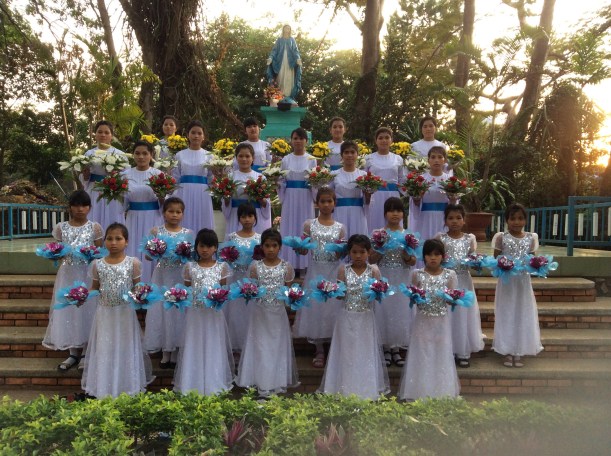
Viet Nam: flowers for Mama Mary/Fiori per la Madonna 

We are so happy to post a first nice contribution from sister Mary Tran from Viet Nan. Sister Mary is a wonderful Catholic sister working to suppor poor children from ethnic minority groups. Through the help of the sisters, these children are able to receive  appropriate education and live in a boarding school where they receive the care and assistance of the sisters. The first two photos attached to the post refer to this year and the last two to May 2015.

Con grande gioia postiamo un primo blog di suor Mary Tran, dal Viet Nam. Suor Mary e’ una meravigliosa suora cattolica che lavora per favorire l’istruzione dei bambini appartamenti a famiglie povere delle minoranze etniche. Attraverso l’aiuto delle suore, questi bambini ricevono un’istruzione adeguata e vivono in una scuola dove ricevono cure e assistenza. Le prime due foto si riferiscono a quest’anno, le ultime due a maggio del 2015.
 

Sr. Mary Tran 

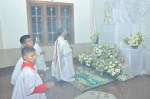
As usual, during the month of May which is dedicated to Mother Mary in a special way, there is a nice tradition in Viet Nam whereby  the children in most of the parish churches offer flowers to The blessed Virgin Mary.
This year the children of our boarding school were assigned to offer the flowers on the first Saturday of May at our parish church in Kontum diocese.

©Huong Tran, Francesco Pesce 


©Huong Tran, Francesco Pesce 


©Huong Tran, Francesco Pesce 


©Huong Tran, Francesco Pesce 


Come da tradizione, durante il mese di maggio che è dedicato alla Madonna in maniera speciale, in Viet Nam i bambini della maggior parte delle parrocchie offrono fiori alla Santa Vergine.

Quest’anno, ai bambini della nostra scuola e’ stato assegnato di portare i fiori il primo sabato di maggio, nella nostra parrocchia nella diocesi di Kontum.


Leave a comment

Jesus is Risen! Alleluia!! Easter song as sung in a small town of India!

We are happy to publish the first blog post of Fr. Pinto, from India, another dearest friend of ours. He is such a wonderful person and very committed and always smiling priest. We often remember him and are grateful to him for great help he gave to us in our pastoral work. We miss him very much but we are happy to see that he is doing well in that great country of India. We are still in Easter time so that sharing this experience of him and his community is still relevant and meaningful.

Fr. Pinto Rockwin

For Christians, Holy Week, starting on Palm Sunday and ending with Easter Sunday (March 27 this year) is considered the source and summit of ecclesiastical and liturgical year. Maundy Thursday, Good Friday, Holy Saturday along with Easter Sunday – are called sacred Triduum whereby Christians commemorate the last days of Jesus here on Earth when he expressed his deep most love for His people through his passion, death and resurrection.

Here, I narrate these three-day experiences of a small town called Kulur in the city of Mangalore, India. The parish is dedicated to the patronage of St. Antony of Padova. On Maundy Thursday, reliving the cenacle experience of Jesus, for the first time, women were included in washing of the feet of the disciples as per the Pope’s directive (see photos). Priest who is considered as a an eminent figure in the society here, the washing of the feet communicates a very formidable message of service and humility as intended by our Lord.

On Good Friday, apart from the liturgical service as prescribed by the Liturgy, there is a particular custom in this part of the world. They call it ‘Bringing down Jesus from the Cross’. A group of persons come in with lanterns and climb the ladder first to remove the nails and then, to bring His body down from the cross followed by the procession of the statue of Jesus and Or Lady of Sorrows in the town (See images). Incidentally, this year witnessed the culmination of 25 years to this custom.

Finally, on Holy Saturday, the church filled with the faithful participated in the luminous liturgy of Easter night and renewed their Baptismal vows. People usually abstain from eating meat throughout the Lent season, thereby, day of Easter when the angels sing, ‘Glory’, peoples acclaim, ‘Alleluia’, they enjoy their fellowship meal in their families. Being a Catholic Priest from few months I sincerely experienced the profound significance of these moments which we commemorate every Sunday, on the day of the Lord.


Leave a comment

A God Who accepts us as we are

Homily of the Forth Sunday per Annum
Fr. Francesco Pesce 
It is not always easy to believe in the God of Jesus Christ. Sometimes it is easier to believe in a God that “distributes miracles”, a God whose love we need to deserve rather than a God that accepts us for whom we are.
Jesus, on the contrary, invites us to look at things more deeply and to see better. Our God is one that walks with us, that gives His help to a foreign widow in Zarephat, and that heals lepers. A God that walks with us daily and that does not look at our merits or memberships, but at our needs and, most importantly, a God that accepts and loves us the way we are.
Believing in a God that first looks at our merits or memberships results in representing a Church that defends itself, that excludes those without or with just a few merits to show off; a Church that becomes an elitarian and closed institution that does not receive nor attracts anybody but a few “elected”. A Church that is not able to influence everyday life, which passes just to the ring road of our lives, stopping in TV programmes or in the lobbies as appropriate.
On the contrary, believing in the God of Jesus Christ, who first of all look at our weaknesses and needs, translates into building “a Church which goes forth”, where pastors have the smell of the sheep (not only of the incense), and where no one feels excluded or left behind.
Around Jesus there have always been and yet there are groups of fanatical and violent people and also extremists that use religion and the Church for their own interests. Pope Francis knows this very well and recently warned against the fact that there are people that do not serve the Church but use the Church for their own interests.
This passage of the Gospel – “But he passed through the midst of them and went away” – represents an extraordinary warning to all of us and for the whole Church. Jesus passes over, He leaves. He leaves when faith joins forces with power; He leaves when clericalism prevails over the people of God and the Gospel. He leaves when the Gospel is reduced to the moral law and it is not its foundation, or when you defend abstract principles and concrete privileges instead of understanding and accompanying ordinary situations.
The Lord goes towards and remains where faith is simple and sincere; where hope is not rhetoric, but confident expectation of a promise that will be fulfilled; and where the charity is sensitive to the cry of the poor and reaches out to every brother, without judgment, pre-condition, or “preference of people.”