ConAltriOcchi blog – 以不同的眼光看世界-博客

"C'è un solo modo di vedere le cose finché qualcuno non ci mostra come guardare con altri occhi" – "There is only one way to see things, until someone shows us how to look at them with different eyes" (Picasso) – "人观察事物的方式只有一种,除非有人让我们学会怎样以不同的眼光看世界" (毕加索)


Leave a comment

The Spirit sends away the fears of the world

The Cenacle, which had seen the Apostles witnesses of the Lord’s Supper, is the place where they had been together to hear His Word many times and now the Cenacle becomes a refuge, a hiding place “for fear of the Jews” as the Evangelist John remembers. And the Acts say to us, “When the time for Pentecost was fulfilled, they were all in one place together.” (Acts 2: 1).

We have to remember that the Apostles in Jerusalem had few friends because they had been opposed to religious and political power, and they were considered  fanatical followers of one of the many messianic factions of the time. They threatened their lives to just preach that Jesus was the Son of God who was truly dead and truly resurrected. And in fact, the Acts tell us that soon the first martyr arrived: Stephen, who is stoned.

Today what are our fears, which make us lock in our groups? If we exclude the Church of the martyrs who, as we well know, still exists in many parts of the world today, we notice that there is also a strong temptation in the Church and among Christians to lock in an elite, often sectarian, excluding the world, seen as evil and an enemy of which to be afraid, and therefore tends to judge rather than love. It may happen that sometimes our faith, our Christian community, our ecclesial group, instead of being a space of fraternity and proclamation of the Gospel, turn into an impregnable fortress, where those in the interior judge the ones outside and also exclude them . “Outgoing Church” according to the teaching of Pope Francis also means not to be afraid and not to judge, but on the contrary be strong in the faith and widen the spaces of welcome.

he-qi-pentecost1

It is in this climate of fear and closure that breaks the Spirit. “And suddenly there came from the sky a noise like a strong driving wind, and it filled the entire house in which they were.” (Acts 2: 1). In that cenacle that has become closed and frightened, the Spirit intervenes, acts and transforms it, changes the hearts of those deceived men and recreates a new fraternity extended to the ends of the earth. That is why everybody was talking in their native language, always remembering the Acts.

Even today the Spirit calls us to look forward, to open the spaces of our heart, to listen to the Word. The Gospel is not a script to be copied, the Church is not a museum to guard. The Christian community of the origins had the courage of the Spirit to welcome the un-circumcised, dared to write the Good News, and it was pilgrim to the boundaries of the known world. Today, it is our time to transmit ‘the Gospel that we have received’, without fear, shame, and wherever we go in this globalized world. “The Advocate, the holy Spirit that the Father will send in my name – he will teach you everything and remind you of all that I told you.” (Jn 14:26).

It is not a simple thing to witness the Church of Pentecost, because it is the Church of Joy (as the Blessed Pope Paul VI reminded us) but also of martyrdom. Nobody feels that we have not have to pay a price, even personal. On the contrary, living the gospel of sacred habits, locked in the sacristies, hidden behind the smell of incense is undoubtedly easier. The Spirit instead calls us to risk the paths of life, to walk the way (ódos), just as the Gospel is called in the Acts of the Apostles. The hardest language to speak is that of who we meet, who is facing us, who will be against us, perhaps believing they do well. The Spirit teaches us to talk about that too.

Leave a comment

Mary Queen of China Our Lady of Sheshan

Last Sunday, Pope Francis at the prayer of Queen Coeli, asked to join the prayer of Chinese Catholics, on the feast day of May 24, the World Prayer Day for the Church in China instituted by Pope Benedict XVI.

In the Sheshan Chinese Shrine, where the Virgin Mary “Help of Christians” is highly revered by Catholics in China, Mary presents her Son to the world with her arms wide open in a gesture of love and mercy. Love and mercy are the main roads where the gospel walks and incarnates in the great Chinese world.

Each year in the sanctuary thousands of Chinese pray especially at the feast of Our Lady of Sheshan, who is also the patron saint of China. Pope Benedict XVI wrote the prayer to the Virgin of Sheshan, entrusting her all over China and the church in China. Benedict XVI had entrusted in the letter to the bishops, the priests to consecrated persons, and to the lay faithful of the Catholic Church in the People’s Republic of China, requesting that the day of the liturgical memory of Our Lady of Sheshan on 24 May become a worldwide day of proximity and prayer for the Church in China.

The church dedicated to the Virgin was built in the 19th century and is located on top of a hill just a few kilometers southwest of Shanghai. The devotion to Mary in China has always been and still is today a determining factor of unity in the church.

We ask, in this Easter time, at the thresholds of Pentecost, to the Spirit to break forth once again in the beloved China Church. The Spirit calls us to an original and always new identity to which we must leavewith confidence. The Spirit tells us that Jesus Christ is not a guardian of a fortress, He is not a reference point of the past, He is not the stool of any egotism, even ecclesial, but is the guarantee for the future.

We know that even in the church in China, there is no future without memory. Our memory, however, can no longer be made by professions of faith proclaimed with the sword in hand, with the tendency to excommunicate others who do not think as us.

The unity of the Church in China cannot be done in accordance with a criterion of selfishness and with the desire to raise other barriers, widening further the “Jericho moat”. It has to be done with the help of the Spirit and with the prayer with Mary. The language of Christianity is a universal language; it is a language of unity and not of uniformity; The Spirit teach us to speak this universal language, even in the great Chinese nation


Leave a comment

Pope Francis pilgrim at the feet of Our Lady of Fatima

The plane with the pope left Rome and arrived in Fatima. This is the 19th apostolic journey of Pope Francis outside Italy. “I ask everyone to join me as pilgrims of hope and peace, and your hands in prayer continue to support me.” In a message addressed to the President of the Italian Republic, he wrote: “As I left Italy to go to Portugal for the centenary of the apparitions of the Blessed Virgin Mary to Fatima, iI am happy to address to you, Mr. President, my deferential greeting and, while I am going to meet pilgrims and especially sick people from all over the world  that are going to that Marian sanctuary to find light and hope, I invoke the Lord’s blessing over the entire Italian nation, especially on those who suffer in body and spirit. “

Receiving a few days ago the Pontifical Portuguese College Pope Francis has explained the deep motive of his pilgrimage: “I will bring a wish of peace and hope to the world“.

“Our Lady of Fatima gave pastors a message against the tide – said Cardinal Secretary of State Pietro Parolin. We were in war time, in 1917, the prevalent thinking was hate, hostility and conflict; resumed as  ‘the useless blunder’ by Benedict XV. Our Lady instead speaks of love and forgiveness, of the ability to sacrifice oneself and to offer as gift for others. “

From the military base where he landed, the Pope will move by helicopter to the stadium of Fatima and then with the popemobile will reach the Marian Shrine where the major events will happen, culminating with the canonization of the two shepherds Francesco and Jacinta Marto. They are first children to become Saints without having suffered martyrdom. Tonight he will visit the Appearance’s Chapel, and after the vespers, we will do the blessing of the candles and the recitation of the Rosary. We too will be spiritually present in Fatima.

In the church of Saint Joseph protector of the carpenters at the Roman Forum, there is also a chapel in honour of “Our Lady of Fatima” (see photo).

image

The story of this devotion in the Roman Forum is singular. At the end of the 1950s, Brother Gino Burresi created a Marian movement of prayers devoted to the small statue of Our Lady of Fatima. The sincere prayers of the many faithful were granted many graces from the Virgin and various miracles, including one for a child,  daughter of a family friend of Pope Pius XII. The Pontiff wished to see this image, and he favored his veneration and wanted it to remain at the church of Saint Joseph’s carpenters. The Chapel is very simple and the silence inspires a deep prayer of conversion. Along with St. Joseph, the presence of Mary of Fatima helps to rediscover the family dimension of faith and the desire for peace.

Today, we will join the prayer that Pope Francis will make in Fatima for the entire humanity. Let us ask for the grace to love the Church with the same maternal love of Mary that illuminates the wonderful secret of the human life, the faith that reconciles. May the Centenary of the Appearances of Our Lady of Fatima give hope to everyone.


Leave a comment

Faith is a love story with God

Faith is a love story with God: “Whoever loves me will keep my Word” (Jn 14:23), reminds us John’s gospel. We have understood as if it were written, “he will keep my commandments.” and this is not true. The Word cannot be reduced to commandments, it is much more. The Word “which is now atwork in you who believe” (1 Thes 2:13) creates, generates and opens unforeseen and unpredictable paths and spaces. Sometimes we think that observing His laws we are loving God. It is not so, because we can be a Christian for fear, for seeking benefits, or for guilt. They have always said, “If you repent, God will be merciful to you. Instead, mercy prevents repentance, the time of mercy is always ahead. What does it mean to love the Lord Jesus? How do you do it? God’s love begins when we accept to be loved by Him. God does not deserve, God welcomes. Just as John’s Gospel says: “and we will come to him and make our dwelling with him” (Jn 14:23).

There is a very instructive passage of the Acts of the Apostles, where Chapter 8 tells the story of the baptism of an Ethiopian eunuch by Philip. The Ethiopian was reading a passage from the prophet Isaiah, and to Philip’s question “Do you understand what you are reading? “ he answered “ how can I, unless someone instructs me? “(Acts 8:31). In the path of approach and growth of faith teaching is needed, a transmission in which who knows helps  younger and more expert.

The whole Church history is done by the effort to put into practice this true work of mercy that is to convey faith.

St. Bernard recalls the various ways in which one can approach knowledge: “There are those who want to know only to know: and this is curiosity; There are those who want to know only to be known; and this is vanity; and there are those who want to know to be built up; and this is true wisdom; there are finally those who want to know to build; and only this is charity. “

Let us entrust to John the Apostle and the Evangelist: “the disciple whom Jesus loved”.


Leave a comment

Europe believe in yourself

On Saturday 25th March, the celebrations for the 60th Anniversary of the signing of the Treaties of Rome, one of the most important historic events in the process of European integration,  will take place in Rome at the Palazzo dei Conservatori on the Capitoline Hill.   On the same day in 1957, all the bells of Rome were ringing joyously in awareness that an historic event was taking place. Twelve years after the end of the Second World War, even though it was divided by the Iron Curtain, Europe was definitely turning a page in its history and moving on.  The so-called Treaties of Rome created the European Atomic Energy Community (EAEC or Euratom) and the European Economic Community (EEC).

Today the Anti-European wind of populism blowing in some places is in no way comparable to those historic days at which Europe must urgently look back.

Citizens of Europe, heirs to the great Greek and Roman tradition, Christians  with their roots in the blood of martyrs, persons freed from every kind of enslavement in the age of enlightened thinkers.  When we look at refugees rejected with force at various European borders, when we look at the agreement with Turkey,  when we look at our Mediterranean Sea, a cemetery over which our huge cruise ships sail, we must perforce be ashamed, at times, to be Europeans, Graeco-Romans, Christians and enlightened people.

They are fleeing from bombs, from the destruction of their homes and from the persecutions of Isis. However, perhaps they are not the real refugees ; perhaps it is our Europe which has now lost its roots in its ancient civilization; an ageing and tired Europe, no longer producing children and  unable to recognize as its own the sons of another part of the world; perhaps it is Europe which is a refugee,  lost, without a homeland, without a landing at which to dock, without a future.

“Therefore, I say to you, the kingdom of God will be taken away from you and given to a people that will produce its fruit.”(Mt 21,43)

These words of the Lord are already happening.  The roots of the tree which does not bear good fruit for everyone are hewn out; freedom is taken from those who know not how to share with others;  the Gospel is taken away from whomever turns it into privileges and goods to be traded with power.  Europe of the universities and cathedrals is, through its own fault, reduced to being a hospice for the old, its nations are at “war” one against another, its borders about to give way under the weight of the dignity of those tired of declarations of principle and have turned their rags into banners and their poor tools into barricades.  Perhaps we need another people who can make the European vineyards flourish, who can reconstruct a lost civilization.  A European civilization which has become an idolater of itself, full of “golden calves” , because the word of true democracy has vanished, the word of the great Western philosophy and the Word of God has also vanished, the Word of God which creates a healthy crisis in you and reminds you about the very heart of your essence, which is to share the gifts of God.

Faced with this true and proper  “European sin”, perhaps the Bishop of Rome, a voice crying out in the wilderness, has been sent by God as the new Moses:”With that, the LORD said to Moses, “Go down at once to your people, whom you brought out of the land of Egypt, for they have become depraved. They have soon turned aside from the way I pointed out to them, making for themselves a molten calf and worshiping it, sacrificing to it and crying out, ‘This is your God, O Israel, who brought you out of the land of Egypt!’ I see how stiff-necked this people is,” continued the LORD to Moses. “Let me alone, then, that my wrath may blaze up against them to consume them. Then I will make of you a great nation.”

Faced with sin, God said to Moses, go and tell them  I will destroy them. The God of Jesus Christ is certainly not wrathful or vengeful, but he will not make compromises with our evil, dissociating himself from a Europe which is no longer itself.  Francis by his example and his appeals, is destroying the old tables of an unjust and discriminatory law, he hurls them to the ground and he does so in the name of God to make the  “European sinners” realize they are making a mistake;  to destroy evil is the beginning of forgiveness and reconciliation. This European sin is a serious thing; the tables of the law no longer exist, they have been destroyed together with the golden calves; Francis is denouncing the gravity of this sin in order to free Europe from its sin. We ask Europe to find the courage (and it is still not too late) to welcome the second tables of the law, this time, as Jesus reminds us,  no longer written on stone, i.e. on the frontispieces of the palaces of power, on the shields of armies, on the constitutional charters but on tablets that are the hearts of flesh of all European citizens.  God has forgiven you, old Europe; we ask you to start being yourself once again; never again a vanished dream, an illusion, a disappointment.   We are awaiting  proof of this, praying and loving you still.


Leave a comment

Abraham went out, not knowing where he was to go

Monica Romano

The season of Lent is, more than any other, a period in which the Word of God invites us to set out on a journey.  An  “important time”- our deputy parish priest, Fr. Paolo reminded us when we were young – many years ago, when he prepared a true and proper “agenda” for Advent and Lent for every one of us, with references to Readings for each day.  He aimed to give us a useful tool to encourage us to read the Bible more often than at other times during the liturgical year.

The journey, the vocation to which God calls us, does not always seem straightforward.  On the contrary, it requires us to take a “ leap in the dark”. I have always been struck by Abraham’s experience; he went out leaving everything and everyone behind and, as the Letter to the Hebrews points out subsequently, “by faith” he obeyed God “and went out not knowing where he was to go”. Here a fundamental aspect of the journey into faith comes into play:  trust, confidence, in God. Many of us have no doubt that God exists and believe that Jesus Christ is His Son, the Saviour who came into this world to redeem us, the firstfruits of the Resurrection which we, too, will experience.   But there is a huge leap to be made from our faith in Jesus Christ to unconditional trust and confidence in Him.

This is often the weakness in our faith: to trust God and entrust ourselves unconditionally to Him. Trust which God mapped out from the minute he became flesh as a defenceless child, who could only live if cared for and loved by Mary and Joseph. God himself was the first to make an act of trust towards men and women, first creating them and then descending into the womb of Mary, entrusting himself into the hands of a family, “an ordinary family”, which in turn placed its trust in God and pursued the extraordinary vocation to which it had been called. Not without times of darkness and uncertainty, some of which emerge from the stories in the Gospels.

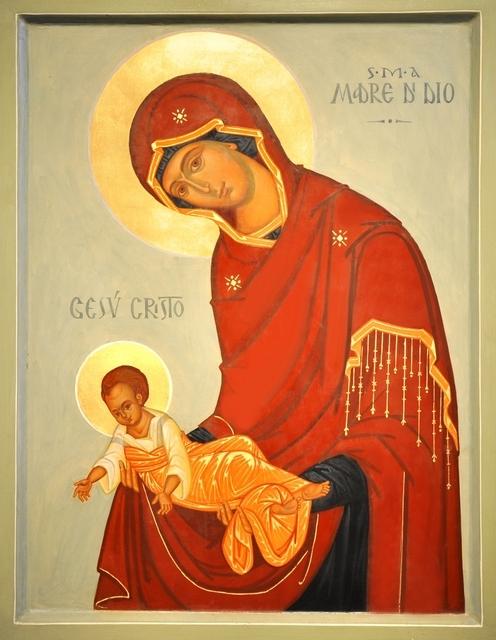
There is a beautiful image which I keep in my heart, painted by the Little Sisters of Charles de Foucault (see image below). Mary is holding  Jesus Child in her arms and, instead of  “cuddling ” in the safe arms of His Mother,  He is stretching  out His arms as if to be taken by the first passer-by who wishes to welcome Him. This original “iconography” reminds me again of the idea of the trust the Lord has placed in men and women, to the point of giving His own life for them, for each one of us and all of us together. Trust that He has asked us Christians to live, we that have believed “even though we have not seen”. Acts of trust which are not just asked of us once in our lives. Later, Abraham was even asked to sacrifice his son Isaac. The meaning of which is that, in addition to the “small”, “daily”, acts of trust in God which we Christians are asked to do in our day to day lives, there can be many larger ones during our lifetime.

Madonna-con-Bambino

The saints are a luminous mirror of this unconditional trust in the love of the Father and followed Him always and no matter what, often persevering when the paths are dark and unclear in their souls and in their everyday lives. For me,  saints are a great consolation because they have shown us that life’s bitter moments can be overcome humanly and lived in the way the Lord asks us to do, with the aid of grace. 

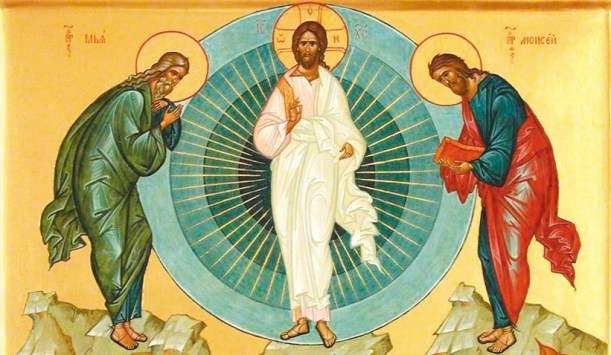
But we see that the temptation of  taking “shortcuts” , the alternative to the “leap” into the dark, appears  immediately in the hearts of men and women, even those who were closest to the Lord and who gave everything, his life, for Him.  In today’s Gospel which follows the First Reading on the vocation of Abraham, the liturgy proposes the story of the Transfiguration of Jesus.  The Lord, Peter, James and John are walking “up a high mountain”. Often, when the Lord is preparing something special as in this case, the Gospel tells us that we start walking, generally under difficult, hostile situations or circumstances. Climbing the mountain, as in this case; the environment of the shepherds – the marginalized ones at the time – or the Magi from the East deceived by Herod when Jesus was born…..Once Jesus and the disciples reached their destination, Peter proposed to prepare three shelters and stay there, just them alone.  “Let us leave everything behind us, abandon this world with its hardships” Peter seems to be wanting to say. Or even, perhaps: “Let the three of us enjoy the company of the Lord”.  It has happened to me on more than one occasion to experience or to meet people who have experienced this temptation.  “Give everything up”, to say it in everyday language and perhaps in a more effective manner; “keep our faith only for us”, within our parish or Christian group,  far from the world that “does not know” or even worse “refuses” the Lord…. The Liturgy of the Word which was wisely “put together” by the Second Vatican Council tells us in these Readings that instead we must not stop but –paraphrasing the words of Jesus in the Gospel today – we must “rise and not be afraid”, like Abraham did. We must walk on our pathway and, after enjoying the light of Jesus, we must, in turn, bring it to the world, to light those dark paths on which we often find ourselves and walk along during our lives.  The Christian vocation does not mean to live in shelters by ourselves, but, as Pope Francis would say, it means opening the doors, go out, and bring Jesus to the world and let anyone who so desires come in.

May this Season of Lent, which I have always considered a propitious gift in my faith pathway, help us to light  the small lamp of our faith and our trust in God, which already have not been disappointed, with the promise of Resurrection.


Leave a comment

A light on our weakness

Thoughts on the II Sunday of Lent 

The First Reading on the second Sunday of Lent  from the Book of Genesis talks about the vocation of Abraham, called upon to set out trusting solely in the Word of God.  We, too, like Abraham are called upon to leave our land. We are at an historic time when crossing the land from the old to the new world has become vital.  Our Western land, our Europe of the cathedrals, is under siege by millions of people seeking dignity and safety. It is not rhetoric to affirm that a new world is being formed.  A Church that still wanted to stay closed up in Noah’s Ark during the deluge, i.e. an Eurocentric Church strong only in its own certainties and traditions, would simply be out of step with the times.  Even worse it would be shut off from the pain of the world.  This pain of the world is illuminated by the light of Jesus which today in Chapter 17 of the Gospel according to Matthew  unveils, for an instant, His Glory.

trasfigurazione-d0bfd180d0b5d0bed0b1d180d0b0d0b6d0b5d0bdd0b8d0b5-verklc3a4rung-transfiguration

Following in Jesus’ footsteps, all Christians are called upon to share the faith in that common territory, among all the latitudes, among all believers and non-believers, that is suffering.  «Jesus alone» in the Transfiguration, which ends with the anticipation of Easter, is only a man among other men.  But it is in that “weak” Jesus, tempted just like us by everything, lives the Glory of God. In Jesus alone and abandoned by everybody, God reveals His Glory and tells men and women that weakness is the home of God.

This is why we must pursue our Lenten journey with trust and confidence in God; life’s hardships do not diminish our Easter momentum because the Lord lights them with His glory and asks us to always know how to recognize His saving presence both in and outside us.

“It is good”, says Peter to Jesus.  Let us start anew from goodness;  even if life is not always easy, it can always be happy if we live it with Jesus, if we know how to understand ourselves and others better with a compassionate eye.

The many things we have to do, preoccupations, the  “noises of the world” often prevent us from listening to the tiny whispering sound by which God makes his presence known. (1 Kings 19,12).

To live a good and aware Christian life requires us to listen to the voice of God within and among us.  God moves our lives, he takes care of us. Nobody is excluded, nobody is left out.


Leave a comment

Ashes, Water and Dust. Thoughts on Ash Wednesday, the first day of Lent

We can all remember our grandparents washing their clothes at the riverside with ashes and water. Ashes on heads on the Wednesday marking the start of Lent, water on feet on Holy Thursday.  The carnival masks are very beautiful but they are only good for a day; then follows life with its hard face of reality, the journey along a challenging course involving all men and women and their entire being, from head to foot..

Lent takes us into the desert and as many families know when divested of their masks they find the party is over and they have to fight day after day and often enter into the desert. The desert is symbolic of Lent, an essential part of our lives.   However, as Antoine de Saint-Exupéry said so effectively: “Every desert, somewhere, hides a well, in every hardship there is the seed of an unexpected resurrection”. It is Easter the ultimate horizon of Lent.  The theologian Andrea Grillo writes: “To restore Lent as a festive initiation to the Paschal Mystery is a ‘great undertaking’, which we Roman Catholic Christians, belonging to the second generation after Vatican Council II, have found has been indicated by that great Council as one of the keys to access our ecclesial and spiritual tradition. To set in motion the symbolic mechanism of a festive journey of expectation, preparation and above all initiation to Easter.”

Pope Francis receives ashes from Cardinal Tomko during Ash Wednesday Mass at Basilica of Santa Sabina in Rome

Pope Francis receives ashes from Slovakian Cardinal Jozef Tomko during Ash Wednesday Mass at the Basilica of Santa Sabina in Rome March 5. (CNS photo/Paul Haring) (March 5, 2014) See POPE-ASHWEDNESDAY March 5, 2014.

“Convert and believe in the Gospel” or “Remember you are dust and to dust you shall return”, the priests will say as they are spreading the ashes. Faith and humility are necessary to commence the journey of conversion towards Easter;  it only needs a financial crisis for many to lose their daily bread, a disease and the joy of life will be wanting. Men and women are dust. And yet that dust, which houses the breath of the Holy Spirit, is still today the best creation of all.  The Holy Spirit bursts into our fragility and calls us to an original and ever newer identity.  We must act according to the Holy Spirit, with that fragile courage belonging to every baptised person which we see on every page of the Gospel making us new men and women every day.

The Lord, through the Prophet Joel whom we select for the First Reading on Ash Wednesday (Joel 2,16-18) asks us to gather people together, young, old, children, married couples, unmarried couples, immigrants for them to receive the invitation to  be reconciled with God, as Saint Paul reminds us in the Second Reading from the Second Letter to the Corinthians (2Cor 5,20-6,2).

In the Gospel, (Mt6,1-6.16-18) Jesus exhorts us  take the journey seriously.  God also walks and comes towards us and we welcome him with prayer, fasting and charity. These are not individual or private Lenten practices, rather they want to express our hearts which move towards God and towards all men and women, who are, from Easter onwards, our brothers and sisters.

May Lent help us to make our interior and exterior world  as the Father’s house where all men and women are brothers and sisters, and not turn it into a marketplace (Jn2,16), where everyone is an enemy and a competitor.


Leave a comment

Pope Francis, true witness of the Joy of the Gospel

22nd February, the Church is celebrating the Feast of the Chair of St. Peter. The Chair marks the primatial role of Peter in the Apostolic College  when Jesus assigned him the task of  “feeding” his flock. Today, on this Chair sits Pope Francis and it is shining with a special light, allowing us to catch sight of the holy Spirit at work in the Church.

Evangelii Gaudium, Laudato Si’ e Amoris Laetitia.   Joy, Praise, Delight. The very names of the documents of the Pope’s teaching  enable us to understand clearly the faith in God and trust in men which live in Francis’s priestly heart.  Biblical joy erupts powerfully:  “I bring you tidings of great joy, which shall be to all people.” A joy which came into the world and is not reserved only for an exclusive club.

Those who speak always and only of  “doctrine” are sad Christians and cannot be good witnesses of the Gospel which, in regard to witnesses, speaks thus of John:” the disciple beloved of Jesus”. The disciples must be taught first and foremost with love, by loving them, welcoming them just as they are,  walking along a stretch of road with them, “infecting them” with a coherent testimony of Christian life.

If we don’t: “stop seeking those personal or communal niches which enable us to maintain a distance from the issue of human drama”(AL) we will be unable to understand the “drama” of the Kerygma;  the Kerygma isn’t doctrine but drama. Announcing the Gospel without personal involvement is not only a useless illusion, it is also counterproductive.  Without the odour of his sheep, the Shepherd is no longer a shepherd and becomes a wolf, smelling only of incense and ink and no longer has the shepherd’s dirty garments but robes of Constantinian memory and so the sheep flee from Him.

«No one has seen God at any time but the one and only Son who is in the bosom of the Father, He hath declared him». Unless he is the God who makes himself known through the Word Incarnate of the Son of Man, this God is not the Christian God but a mere concept or even an ideological instrument who says nothing to our hearts.  God’s people need Shepherds who warm their hearts not Instructions for Use. After all,  warm hearts are like clay, more malleable and gradually masterpieces emerge; hearts full of instructions for use are beautiful on the outside but do not beat within and cannot be shaped in any way whatsoever.

At times not only do we not want to make the effort to get to know the God of Jesus Christ, but often not even Man; man is a mixture of mud and Spirit. The mud is an important thing; it is the sweat we see every day in our streets;  it is the blood that so many families spill to reach the end of the month with dignity; it is the “marvellous complexity” of life. The Spirit needs this mud, the Church needs it, we all need it; in order never to forget that All is Grace.

“But as many as received him, to them gave he the power to become the sons of God”.  In a certain sense, we are not born Sons of God but become them; we become them by welcoming Jesus and imitating his life of love, which are the beatitudes.  We also gradually become a family; and when we are unable to for many reasons, the people remain, forever, the image and likeness of God.

Often we waste too much energy fighting evil; “The light shines in the darkness and the darkness has not overcome it”. To receive the love of God and then manifest it immediately to those we meet, simply, with joy and unconditionally, like a secret of the heart. To love unconditionally.  Many times in the countryside, we have seen the light expanding gradually at dawn and the darkness fleeing from the sunlight. It is only light which overcomes the darkness, because it overpowers it, the law can sanction it but no more than that.

The Magisterium of Pope Francis is a “perilous” light; it is enough to go to a parish and talk to the people to experience how people feel respected, loved and encouraged by His words and His example.  We can almost feel the fatherhood and motherhood of the Church physically.

A testimony, that of Pope Francis, of life, fidelity to the Gospel and to the Tradition of the Church (not to the precepts of men). A faith which is coherent with honesty, sobriety, justice and charity and which knows how to transmit the joy of meeting the Resurrected Christ to the new generations.

The Spirit summons us to an original and ever new identity to which we must abandon ourselves with faith.  The Spirit tells us that Jesus Christ isn’t the guardian of the fort,  he’s not a point of reference of the past, he is not a footrest for every egotism, even ecclesial, but a guarantee for the future.

We know very well that there is no future without memory of the past. Our memory, however, cannot exist of professions of faith proclaimed with a sword in hand, with the tendency to exclude the weakest. The unity of the Church cannot be maintained by a criterion of egotism and the desire to raise barriers, by widening the “the walls of Jericho” even more.

The language of Christianity is a universal language; it is a language of unity but not uniformity; The Spirit teaches us to speak this universal language every day of our lives.


Leave a comment

There are no enemies

Often our system, in order to continue standing, has to identify an enemy, it has to create one.  This is also true in children’s education.  Many of us in Italy will remember when our grandparents used the term “Austrian” in a derogatory manner: if you don’t behave properly I’ll call the Austrians, they used to say. Later we referred to “the Communists” and today, perhaps, the “Muslims.

One of the first teachings of the Gospel is that of the idea of the enemy: there are no enemies, there are men.  Even the Church has enemies – we have been taught – and therefore we must defend it from relativism, subjectivism, laicism etcetera, but Jesus never defended himself; and similarly neither did Peter and Paul. There is an entire history of enemies we have fought against while evil was in our midst: power, money, fear of losing our dominant position.

Thus, when Jesus says “«whosoever smiteth thee on thy right cheek, turn to him the other also»”, he is telling us to go beyond the enemy.  In the Gospel according to St. John, Jesus was slapped but he rendered it ineffective: “if I have spoken evil, bear witness of the evil: but if well, why smitest thou me?”

Jesus is asking us not to return violence for violence otherwise this will grow and turn into an interminable crescendo.

The logic of offering the other cheek, being stripped of one’s garments and dragged before the tribunal means recognizing violence, giving it a name and  “fighting it” like the sun conquers  the darkness which is gradually overcome by the expanding light.

We must begin to live this change by modifying the private spaces of our responsibility. Only men of the Beatitudes can build peace and integrate naturally into the great peace processes of history.  The powerful, the privileged, the lobbies will always be foreign bodies in the peace process and become, almost without realizing it, allies of war.

When I want to qualify nonviolence, I say justice, respect of diversity, peace, the common good.  I say the Beatitudes, words which give multiple names to this single truth of which Jesus was the first witness. Jesus is the witness of nonviolence, this nonviolence of the many names which are the beatitudes.

When someone has authority, a company, a position of leadership, or when a country owns resources, they should not defend them by the sword. Jesus said to Pilate: if my kingdom were of this world, my servants would fight. To fight with the sword is to kill, it is the violence which creates only defeats and no victors. In fact, our history is a river of blood spilt in the name of the principle that without a sword a kingdom cannot go on existing.  This is why we are always at war. «Put your sword back in its  place» said Jesus to Peter, otherwise right will always be with the strongest, the most violent, the cruellest and the best armed.

We must go back to the radical teaching of the Gospel, as St. Paul reminds us in his letter to the Corinthians.  The Corinthians criticized  Paul for his simplicity in announcing the Gospel not at their level of knowledge and culture. Paul answered by comparing the announcement of the Gospel to a building: the builders will be judged by whether they have placed Jesus Christ as the cornerstone,  not by their highly cultural discourses but empty of spiritual content. Let us make the crucifix the foundation of our life and not an aggressive tool of civil religion.