ConAltriOcchi blog – 以不同的眼光看世界-博客

"C'è un solo modo di vedere le cose finché qualcuno non ci mostra come guardare con altri occhi" – "There is only one way to see things, until someone shows us how to look at them with different eyes" (Picasso) – "人观察事物的方式只有一种,除非有人让我们学会怎样以不同的眼光看世界" (毕加索)


Leave a comment

The king is dead, long live the king!

Donald Trump will be the 45th President of the United States of America. The new president will swear his oath of office on the Bible; a private ceremony will be heldin the White House Blue Room, followed by a public ceremony on 20 January, traditionally held before Midday, when the President’s term officially begins. The oath of office of the President of the United States of America is traditionally taken before the chief justice of the US Supreme Court and reads“I do solemnly swear (or affirm) that I will faithfully execute the office of President of the United States, and will to the best of my ability, preserve, protect, and defend the Constitution of the United States”.

The president will take the oath on the Bible. Traditionally, this is not just a formal act but has a profound meaning. Trump is also a very wealthy man. In the Bible, Jesus considers wealth merely a tool and warns us that it often becomes evil because men use it as an instrument of power and domination, even as a means  for exterminating the poor. We can all see how, worldwide,there is a planned and conscious effort to exterminate the poor. We have invested huge sums of money in producing weapons, as a result of which millions of people are killed. Regarding wealth, it is our responsibility to do what we can to transform it into an instrument for liberating mankind.

This is the biblical meaning of the love of God. Not empty words, but actual facts and solid commitment to achieve economic solidarity, social policies and an inclusive – not exclusive – welfare system, the awareness that the United States is a great country belonging to a global world, where there is urgent need for the globalisation of solidarity, not of indifference.

Let us pray for the United States of America and its new president that he may fulfil the Word of God, on which, in a certain sense, the entire American people take the oath, and live up to the Constitution and history of that country.


Leave a comment

Why me? Testimony of a Missionary of Mercy in Mali

We have received and are pleased to publish the testimony of a dear friend of ours appointed by Pope Francis as a Missionary of Mercy, Don Toussaint Ouologuem, a Mali priest.  We are very grateful to Toussaint for this beautiful testimony for, knowing him as we do, we know that he will be capable of announcing the love and infinite mercy of our Father to whomever he meets.

Fr. Toussaint Ouologuemi

If they had asked me to choose a priest in my diocese to be a Missionary of Divine Mercy, I would never have chosen myself. Not because I have a lack of faith in myself or a low opinion of myself but because it is Mercy which is involved, Divine Mercy.

Summing up all my sins, weaknesses, spiritual, intellectual and moral frailties and adding to these my severity of judgment, my search for justice at any cost, the difficulty I have in giving people a second chance, above all those who have in some way, offended me. And to conclude, my youth and lack of experience in the priesthood ( two and a half years). Putting all this together, I would certainly not have chosen myself as a Missionary of Mercy. A sinner, too severe, too young and little experience, I would have defined myself as inadequate for such an important mission.

But here I am; chosen by the Pontifical Council for New Evangelization, through the Urban College, approved by my bishop and designated by Pope Francis as a Missionary of Mercy. And I ask myself: why me?

Regardless of the Urban College’s choice, regardless of my bishop’s approval, his Green Light, regardless of the letters and e-mails between myself and the Pontifical Council for New Evangelization, regardless of any other human intervention,  I can’t help but see the hand of God in the fact that I was chosen. It is my faith which is asking this of me, my spirituality that is telling this to me, my vocation to the priesthood that is shouting it out loudly. So, I ask myself: why me?

This is the question I have never stopped asking myself and God ever since I was approached the first time because someone, somewhere proposed my name.  With huge joy, with fascination on the one hand and tremendous fear on the other, I willingly accepted this mission.  But ever since then I have been asking myself: why me?

I am now sure that I will ask myself this question way beyond this year, until the end of my days, seeking to understand better the full meaning hidden and desired by God, a meaning both for me and for others.

A few days after my consecration as a Missionary of Mercy, after a Eucharistic Adoration in one of the Churches in Torbe, a holy hand gave me a book, a book called «We  cannot keep quiet about what we have seen». I started to read it straight away a sentence struck me, a sentence which answered my continual question. In fact, the sentence said «when God touches your life he assigns you a duty: to give yourself wholly to Him and be happy in Him in order to announce it to others».

Between conferences on Mercy and missions on the radio and the TV, between homilies and Penitential Celebrations and some personal encounters, I try in every way to carry out my mission as a priest promoting Divine Mercy and spread word of my happiness. But it is never enough. That is why I have never missed an opportunity of asking people to pray for me, just as Pope Francis does on many occasions,  asking people to pray for him.

Many stories about vocation in the Holy Scriptures make us understand that God, for the most part, doesn’t choose someone because that person is already able to accomplish his mission, but he chooses him in order to make him able, suitable for that mission. Therefore it is my duty to be vigilant in order to receive such Grace as God may give me for my mission. May God help me in this.!

This is a Year of Grace which has been granted us.  It is a year in which we have the task of meditating (personally) on God’s Mercy, benefiting from his Divine Mercy (by the sacrament of penitence) and living it (the 14 works of Divine Mercy).

Towards the end of his Bull, Misericordiae Vultus, Pope Francis says:” In this Jubilee Year, let us allow God to surprise us”. I wish to add that we need to allow ourselves to be surprised … by ourselves, : surprised at what we can do that is  beautiful, great and extraordinary meditating on, benefiting from, living and sharing Divine Mercy. God bless us all!


Leave a comment

A fragile but already eternal reality

A spiritual reflection after the tragic earthquake in central Italy.

Fr. Francesco Pesce

An unending list of names. The Bishop of Rieti began the Funeral Mass for the earthquake victims from Amatrice and Accumoli by reading the names of the dead, one by one.  Names, stories, faces, families whose lives have been shattered.  It made me remember the episode on the Sea of Tiberias, in Galilee, described in Chapter 21 of the Gospel according to St. John. In that passage, at the end of the Gospel account, after the crucifixion of Jesus, no-one spoke and no-one knew what to do or to say. The atmosphere was oppressive. Jesus was already dead and hope was dying. Peter took the initiative to rid himself and the others of discomfort  and said “I go a-fishing” (Jn. 21,3) and in this way their former life seemed to be returning but “ that night they caught nothing” (Jn. 21,3).

So many nights in the Bible, in life, during our own times; so much fragility in our lives, in our families.  This is a natural weakness the nature of which is corrupted by the mystery of evil and sin. Jesus asks us to cast the net again, to continue to live and hope. The net of our life is destined to be filled because it is cast upon the Word of the Resurrected Christ, even though the Apostles had not recognized Him, even if sometimes, when faced with tragedies, we struggle because life isn’t a principle to be defended but a great adventure to go through with the aid of Grace. We believe that there will always be a new dawn where we can cry out “it is the Lord ” (Jn. 21,7) –John’s cry of love, or as in the Song of Solomon “my beloved” (Song 2,8). An Easter cry, of love which conquers the shadow of death. While I was watching the Funeral Service on the television, I was struck by the fact that nearly everybody took Communion, not something common these days, even during important celebrations.  There was an almost urgent and compelling desire for the Bread of Heaven, the real one, which we all need, “Lord, evermore give us this bread. And Jesus said unto them: I am the bread of life: he that cometh to me shall never hunger and he who believeth in me shall never thirst” (Jn. 6,34-35). In fact, we celebrate the Eucharist “Awaiting His return”, because we believe that a love that dies, a love that is destroyed finds the gift of the God of life.

Today we are celebrating together throughout Italy the body and the flesh. The word flesh in the Bible, indicates all that is corruptible, fragile, mortal. The entire Christian faith is a rapport between carnality and spirituality. The expression “flesh and blood” is a typically Hebrew expression to denote  “fragile life” When Jesus is “flesh and blood” he becomes weak, limited and therefore accessible because he takes on our weakness through which he gives us His eternal life. Today in Amatrice and Accumoli we have yet again celebrated a fragile reality, but an already eternal one.. We have celebrated the “bread and wine”, simple food from the table of the poor, signs of the solemn poverty of men and God. “Give us this day our daily bread” is still the cry reaching us from the towns and villages devastated by the earthquake, these places where Saint Francis and Saint Benedict trod.  It is a cry already listened to by Him who conquered death through love. “Thus saith the Lord God; Come from the four winds, O breath, and breathe upon these slain, that they may live. So I prophesied as he commanded and the breath came into them, and they lived, and stood up upon their feet, an exceeding great army.”(Ez. 37,9-10)


Leave a comment

Indians: Mother Teresa, truly a saint !

We are happy to receive and post some reflections about Mother Teresa received from India – Catholics, Hindus and non-believers. These once again confirm the love and highest esteem that Indians have for this woman who put at the center of her life the poorest of the poor.

“It is our great privilege to celebrate the canonisation ceremony of Mother Teresa”, states Fr. Jerin, who is from Kerala, a state where there is a strong Catholic presence. “She is more than a mere religious figure for Indians. Mother is pure and radical symbol of unconditional love, deep sense of compassion, strong faithfulness towards God and the real face of Christian Charity for Indian civilization.” Fr. Jerin, who studied in Rome a few years ago, continues: “Her canonisation is an honour to our own society, in which the democratic values have a deep roots. Mother Teresa Sisters are still promising figures and extraordinary Christian testimonies among other religious communities”.

According to the father, the whole India is awaiting for September 4, when the blessed Mother Teresa will be canonised in St. Peter by Pope Francis. Kolkata, which is the adopted hometown of Mother Teresa, is the powerhouse of celebrations, that take place all over Indian States. Various  delegations, including religious, political and regional representatives, will participate in the ceremony in Rome. The father explains that symposiums, film festivals, open air galleries, road shows, and many more initiatives have started to cherish each moments of this unforgettable event as a sincere tribute to Mother Teresa. Masses, prayer vigils, novenas, processions, relic veneration rallies, pilgrimages to Mother Teresa Centeres are the main attractions of spiritual preparations organized by Christian Communities.

image

Among the Indian non-Christians, Mr. Shantanu, originally from North of India, is enthusiastic: “She is truly a Saint! Totally selfless and always in the service of those sufferers who are the most unfortunate and the most disadvantaged, marginalised and excluded of all.” He also feels that “Mother Teresa’s passionate engagement in this most humane of causes deserves every recognition – and the sainthood is indeed a fitting award consistent with her sacrifice (even if she did not consider it that way – at all!) which is another compelling reason for this accolade.”

According to Mrs. Vasundhara, a Hindu lady in her fifties, “Mother Teresa holds a special meaning for most Indians whether or not they belong to the Catholic religion. For the poor people of this part of the world she has always been a Saint – who left her home in Central Europe – far far away and came as an angel of hope.”  Mrs. Vasundhara continues by recalling what Mother Teresa did for the abandoned ones, providing caring for those who were rejected by their families and by Society – at large – excluded for no fault of theirs – other than their falling victims of disease. “She was brave and transcended fear of infection – in embracing them and accepting them and nursing them in her ‘home’, showing extreme magnanimity and generosity! She was loved and admired universally – by people of all religions, and of any caste or creed. A goddess incarnate!”.

image

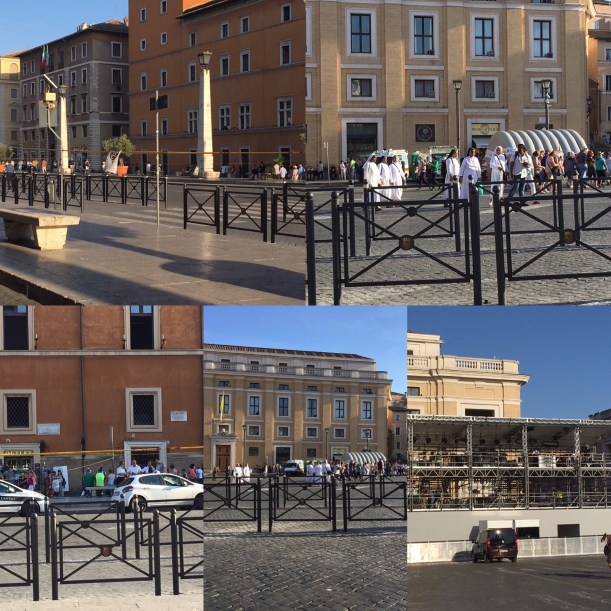
Around St. Peter square the day before the canonization cerimony

Another Hindu lady, Mrs Roy, had various opportunities to meet Mother Teresa and shared something from that experience with us. “Luckily, I have met her three times when I lived in Rome in the 80s and 90s. She was always so affectionate and blessed my little son each time. He has done very well in life – both academically and in career”. Mrs Roy believes that this encounter with Mother Teresa might have worked unconsciously in contributing to his decision to have worked for two months when he was in his twenties, with an NGO in Kolkata focused on the welfare of disadvantaged children. “A wonderful experience for a young person with desire to end misery for the unfortunate children” – she adds. “To me, Mother Teresa struck me as divine – no less. She had an aura around her which showed that she was indeed very special already, forty years ago. The sainthood she is receiving now is only a natural extension of the way she lived her life – for the benefit of humanity and in the service of mankind. Her contribution to the cause of the poor and the downtrodden is unsurpassed.”


Leave a comment

My brief encounters with Saint “Mother” Teresa

We are happy to post a beautiful and touching sharing of our dearest friend fr. Valerian, a Salesian Indian priest living in the State of Maharashtra, the the big city of Mumbai (Bombay) is located. He writes us on the occasion of the forthcoming and much waited for canonization of Mother Teresa of Kolkata, which will take place in St. Pietro next Sunday and will be presided by Pope Francis. this witness by Fr. Valerian ok one side makes us very grateful to him to have shared these direct experiences of knowing personally Mother Teresa, experiences that he keeps in his heart and as memories.  On the other side we cannot but feel some regret for not being able – many of us – to meet this little yet big saint of our times. Let us pray that Mother teresa be closer to us with het maternal love and her intercession. 

From India Fr. Valerian Pereira, sdb

Whoever said: to live with the saints in heaven is all honour and glory, but to live with the saints on earth is quite a different story, must be talking of pseudo-saints. Mother Teresa, who will be canonized by Pope Francis on 4th September 2016, to me was certainly no pseudo-saint, as a few biased critics make her out to be.

image

My first personal contact with this frail looking nun was at the Mumbai airport in 1987. As I walked through security into the departure lounge, I saw a crowd of passengers standing in awe and gazing at a person who was seated quietly, all by herself. As I got closer to the scene, I recognized Mother Teresa in her blue-bordered white sari and her simple wooden-handle shopping bag. Something within impelled me to approach her. With a gentle smile and a welcome nod, she invited me to sit down by her side and as I did, I introduced myself as a priest and a Salesian of Don Bosco. Right from the start of our brief conversation, she came across to me as very motherly. I told her I was in Pune and requested her for more than an “autograph” – a message for my community of young seminarians. This is what she wrote: “Teach your seminarians to find joy in sacrifice.” I was reminded of Mama Margaret’s words to her newly ordained son, John Bosco: “Remember, to be a priest is to begin to suffer.” Over the years, I have understood that “joy in sacrifice” is the essence of motherhood, just as it is of all true parenting. I have experienced its wisdom and have felt its challenge in my own attempts at being a Salesian priest and pastor.

Her precious time permitting, Mother Teresa attended the annual meetings of the CRI (Conference of Religious India). What impressed me was that though she sat through the sessions, mostly quiet and without pretensions, her humble presence and lively interaction with members of the assembly during breaks had a formative influence on us all.

But my best memory of Mother Teresa was a spiritual retreat I was invited to animate for the Missionaries of Charity in Calcutta back in 1990. The retreatants were superiors of the many Missionaries of Charity communities in East Africa and Asia and their foundress was to attend as well. Mother Teresa arrived at the airport late night on the eve of the retreat. She was received warmly by a small group of sisters, and was treated respectfully by the immigration and customs officials. However, there was one problem. The young novice from Poland who accompanied Mother Teresa was held up at the immigration desk since, at that time, communist Poland had no diplomatic relations with India. The Chief Immigration Officer could not be immediately contacted for special clearance. The officer on duty suggested that Mother Teresa could proceed to her convent. The Polish sister, they assured her, would be well cared for while she awaited clearance. Mother Teresa remained with the sister saying: “You have held back my daughter and I must stay with her.” The Chief Immigration Officer was finally contacted by 2 a.m. and an entry permit was granted to the young novice. What a motherly testimony of “joy in sacrifice”!

The next morning, despite a sleepless night, Mother Teresa was punctually present at 7 a.m. in the chapel, for the first meditation conference of the retreat. She devoutly participated in all the liturgical services and listened attentively to the talks while seated in the last row. Overwhelmed by her humble presence, I concluded each talk by sitting by her side and inviting her to share her own reflections on the topic. She did so, humbly and reverently. While I preached from the front, from a pedestal of theory, she preached from the back pew with words incarnated in life-giving acts of selfless motherly love for the poor, sick and abandoned.

Preaching in the presence of a saint whom I always held in high esteem, was a privilege albeit embarrassing. Therefore, when she approached me with childlike confidence for spiritual guidance that was followed by her confession, my nervousness knew no bounds: I just could not remember the formula of absolution! Instead, Mother Teresa was one penitent who converted me into a repentant confessor.

At the end of the retreat, she thanked me profusely and graciously gifted a rosary for my own mother. She even accepted my request to visit Don Bosco Boys Town in Nairobi the following day. Unfortunately, she could not make it as she had caught the flu.

image

In a world terrorized and torn apart by forces of hate and destruction; in a society rife with crimes against the dignity of women the canonization of Mother Teresa on September 4 will stand out like a beacon of selfless motherly love. It will not only place her among the saints of the Catholic Church, but will inspire all people to recognize and respect God’s “motherly” countenance in the face of every woman who walks on our streets and lives in our homes.

May God’s Word, “Whatsoever you do to the least of my brothers and sisters, you do unto me”, find concrete expression in our lives as it did in the life of the great Missionary of Charity, the “Motherly Saint Teresa”.


1 Comment

Mary Magdalene and women: faithful disceples of Jesus

Fr. Francesco Pesce and Monica Romano

As expressly wished by Pope Francis, the Congregation for Divine Worship published a decree on 3rd June 2016, by which the celebration of Saint Mary Magdalene, which was obligatory memory, has been elevated to the level of a liturgical feast day. Archbishop Arthur Roche, Secretary of the Congregation, explained that the Pope took this decision during the Jubilee of Mercy “to emphasize the importance of this woman, who showed great love for Christ and was very dear to Christ”.

At the end of Jesus’s life, Mary of Magdala (or Magdalene) was with Mary and Saint John on Calvary, standing underneath the Cross (Jn 19.25). She never fled in fear as the disciples did, she never denied him like Peter did, but was present at all times, from the day of her conversion until she was under the Cross when Jesus died. She was the first person, that Easter morning, to whom the Lord appeared and called her by name. Continue reading


Leave a comment

The other half of the Church

Fr. Francesco Pesce and Monica Romano

You have followed in recent weeks news on the topic of the role of women in the Church. A topic not much treated to tell the truth ( at least in Italy ), with a few “exploit” at times a bit childish, picked up by some newspapers but that then fall on deaf ears. Speaking to the International Union of Superiors General gathering these days in Rome, in responding to a question from a female religious, Pope Francis said he was willing to form a commission to study the issue of women deacons. A topic of a conference held precisely in the days before in Munster, Germany, sponsored by the KFD and other lay organizations. Even at the last Synod of Bishops on the Family, Mon. Paul Andre Durocher – Bishop of Gatineau, former President of the Canadian Bishops’ Conference – had requested access for women to the diaconate which, according to tradition, is not directed to “sacerdotium sed ad ministerium“. In the 90s Cardinal Carlo Maria Martini had hinted at the possibility of the female diaconate and it emerged that there was still need to further study the nature and practice of women deacons in the early Church. In an article by Civiltá Cattolica of 1999, the main aspects of the debate were analyzed , focusing on the distinction between a female diaconate intended as a service (“diakonia” in fact ) and the diaconate as a first step to the sacred orders, such as that for men, from which women are excluded in the Catholic Church. A few weeks ago, some controversy arose about the words of Enzo Bianchi, prior of the Bose Community , who claimed that women could offer the homily.

But what do women , especially Catholic ones, think of those things that affect them? Of their role, their contribution in the Church? We seem to observe that women engaged in the forefront of the Church life do not talk much about this issue, while their actions speak louder than words. And, their contribution in the parishes, in educational institutions, in charitable work, in hospitals and welfare centers and missionary activities is simply extraordinary. Women already have a role in the Church: help the priests in the management of many parish activities, they are at the forefront in the missions, they guide entire religious orders including international ones, teach the Bible and Theology … It should be these women to provide their points of view on their role in the Church. Avoiding standpoints that are weak and covered in a backward feminist approach, which hardly represent them and are unhelpful in launching a global re-valuation of the role of the woman in the Church that – we must accept – is absolutely necessary, for the benefit of the whole People of God, Pope and bishops included.

img_1185-1

Particolar from a painting by Marco Rupnik, Centro Aletti (Rome)

Let’s analyse each steps. The Bible sets off saying man and woman are created together in harmony with equal dignity. Regrettably, misleading interpretations about sin, which are not entirely overcome, contribute to giving the women a  subservient role to that of man, with few places in society.

In the Gospels Jesus performs a real and true revolution: he defends an adulterous woman from death by lapidation; he stops to talk to a Samaritan woman – Samaritans were deemed as “heretics” -; has amongst his dear friends following him several women…not to mention the role of Mary, the Mother of God, and that the Resurrected appears first to two women, who become the first announcers of Easter. But it was the Apostle Paul who, despite his equalitarianism vision of the world – “There can be neither Jew nor Greek, there can be neither slave nor freeman, there can be neither male nor female — for you are all one in Christ Jesus” (Gal 3,28) – to operate resizing: “I want however you to know that head of each man is Christ, and head of the woman is the man, the head of Christ is God. The man should not cover his head because he is the image and glory of God, the woman instead is the glory of man. Indeed man does not proceed from woman, but woman from man; neither man was created for the woman, but the woman for man”. However he recognises “however, in God, neither the woman is without man, neither the man is without a woman; just as the woman comes from man, likewise man is born from woman; everything comes from God”. Certainly the rigid farisaic upbringing and contacts with pagan populations who – no doubt – in Paul’s eyes were displaying very libertine habits, heavily influenced the position on the woman, affecting her role in the Church. An interesting article of the biblical scholar Marinella Perroni reinterprets the alleged misogyny of Paul and explains how the Apostle of the Gentiles appreciated and took advantaged of the  women for his apostolate ( http://www.stpauls.it/vita/0901vp/0901vp85.htm).

In the millenary continuing history of the Church, until now, many are the examples of women who have been able to impose themselves through holiness, the witness, and the courage of their lives. Often with origins, vocations and very different paths. We think of Matilda of Canossa, a noble woman’s, who helped the Pope at the time of the investiture controversy; Monica, mystic mother of Augustine; Hildegard of Bingen, a benedictine sister and prolific writer; Clare of Assisi, so close to St. Francis; Teresa of Avila and Catherine of Siena, the first women proclaimed Doctor of the Church by Blessed Pope Paul VI in 1970; and many others, up to the modern and contemporary times, like Teresa of Lisieux, Edith Stein, Simone Weil, Gianna Beretta Beretta and Mother Teresa of Calcutta – the latter will be canonized by Pope Francis in September.

The recent popes have shown to understand the importance of the role of women in the Church and have taken significant steps in the journey towards full ecclesial development of the “feminine genius”. But in this, as on other issues, the Church takes its time. The problem now lies in a part of the Church institution that has fossilized into a rigid and conservative apparatus, often experienced as a place of power, which does not precisely address the problem of how to best engage women for the good of the Church. Or even worse, suffering from misogyny, as indeed also a part of our society.

But it is also true that many situations may appear to us different from the way they are because we do not look ahead and do not analyze the issue with greater breath and complexity of views.

In many churches of Europe where the decrease  in vocations and more generally the crisis of faith are more serious, women still play even more roles of responsibility. For example, helping the priests – who administer various parishes across the territory precisely for lack of priests – to open and administer the churches, lead the prayer, even distribute the Eucharist. This also takes place in countries outside Europe, for slighly different reasons – big numbers and immense, often poorly connected areas. Altar girls, hardly seen in Italy and especially in Rome until not too long ago  especially when the Pope would celebrate Mass in a parish, had already been normal practice for some time in other countries, especially in the North of Europe. There are many women, even secular, engaged in several departments of the local church and  assisting the numerous religious orders through associations of the faithful in several parts of the world …

Of course, some questions are legitimate. Why is it that Superiors of great religious orders cannot participate in the conclave and elect the Pope, or at least be part of the meetings before the conclave is held? Would not it be possible for qualified women to be part of the committee that advises the Pope on the reform of the Curia, without having to become appointed cardinals? Such proposal, of women being appointed cardinals, Pope Francis does not seem to have taken into account as he noticed a sort of clericalism: commenting he said that “women must be valued, not clericalized”.

Our response to these issues and questions is to look beyond, returning to the Church of Pentecost and of the Council. The Church of the beginnings described in the Acts of the Apostles tells us that we must be guided by the Holy Spirit. The presence of the Spirit is life for each of us.

Part of the Church thinks of itself in narrow terms, of categories, of past, without being enlightened by the Spirit who gives life. The present and the future await creative responses, which put man and woman, different and complementary images of God, to the service of the Church and the world. If we talk according to the Spirit, our word must be both masculine and feminine. We require a Church where the sensitivity and the intelligence of the woman is also at its full service even in processes involving consultation, decision and governance. But we must not fall into clericalism, the careerism, or – as the Pope recently still warned- in feminism in the Church. It is essential instead to implement the indications of the Second Vatican Council and deal with this issue within that of the need for a wider participation of the laity in the Church’s life. Starting with the problem of theological and biblical formation which, at least in Italy, is still mainly addressed to priests and religious in terms of curricula and organization, which does not always facilitate the participation of the laity. And riconsidering the areas of services provided by priests and religious in the Church. Should they guide all ecclesial congregations? Could more space be given to lay professors in pontifical universities? Would it be inappropriate, for example, to entrust some offices to lay people, allowing more lay people to teach, and leave to priests (in light of the crisis of vocations) the ministry with the people and the administration of the sacraments? It is true also that those in charge of dicasteries and offices of the Church are helped by laity, including experts as consultants, and many consultants are lay people, including women. The number of women who teach religious subjects is also increasing, even biblical and theological subject matters, as well as those in charge of departments and faculties in pontifical universities, and probably are not an exception in many countries of Europe, perhaps even out of Europe.

Let’s us not fall into temptation of viewing the Church as a monolithic institution, often with Western criteria, detached from a specific cultural or historical context. What matters is the full participation of women and the laity in the Church, rather than equal roles for man and women in the Church. Being well aware that Christian anthropologic vision of man and woman by God does not use our common sociological, psychological, historical parameters …

Perhaps what we should work on is a greater participation of the church community from “the bottom”. To enable the Church and the Pope to benefit from the contribution of the laity, some of them having a solid theological preparation and actively engaged in different realities of the Church, often at the forefront at various levels of the pastoral life. But this applies not only to the laity (and women), it also applies to priests and religious. This is why we believe one should look beyond, with a much broader perspective, rather than thinking in terms that are likely to present the issue as trendy, ill suited to the exercise of the ministries in the Church. “They were all together in one place” (At 2,1). A few days ago, the Church celebrated Pentecost. In the Upper Room, the meeting place of the washing of tha feet and the institution of the Eucharist they were all together. Certainly the fear united them, yet they were all together. In the get-together at Pentecost the Spirit bursts and makes all things new. The Church must always start from this togetherness allowing to be guided by the Spirit, because this is the only way to allow the presence of the Risen Christ. Let’ us not betray the Risen One and let not drop the breath of the Spirit. Fruits rather than good intentions will bear witness to what we all – men and women, laity, clergy and religious – have done for the Church.


Leave a comment

The priest celebrates the Resurrection and accompanies the pain of the world

Celebrations for the Jubilee of priests chaired by Pope Francis

Fr. Francesco Pesce

In these two days which see the celebration of the Jubilee of priests, priesthood is at the centre of our prayer. In the Roman canon we read: “You who wanted to accept the gift of Abel the just, the sacrifice of Abraham our Father in faith, the pure and holy oblate of Melchisedek your high priest”.

The Letter to the Hebrews tells us that Jesus is priest according to Melchisedek, not because He belonged to cast. It would be tragic if priesthood belonged to a cast, as sometimes history showed, to the cast of warriors and merchants.

The Book of Genesis gives the description of the encounter between Abraham and Melchisedek. I believe from this meeting on the mountain we can draw several points of reflections on priesthood. Abraham had just come back winner in an epic battle to free his nephew, Lot. Melchisedek welcomes him and offers him bread and wine. Abraham bows to this King. The priest must have authority, be hospitable, be able to share and give. Melchisedek was king of Jerusalem, city of peace. The priest must also be a man of peace. “Christ our piece” will say Saint Paul. Pope Francis has again given new emphasis to a non aggressive Church, fighting against everybody or in a continuing state of defence because it is attacked by the outside world.

Melchisedek then blesses Abraham: “Blessed be Abraham by God, highest creator of heaven and earth”. A priest is the man of blessing and this blessing carries on for all the people and for all the times. Nor sin neither terrorism nor our sins can ever interrupt God’s blessing. It cannot be interrupted yet it reaches each man. Further the Scriptures say: “Blessed be God the Highest who placed in your enemies in your hands”.

Enemies are defeated by our blessings. Even more reason for the priest to be a man of dialogue, of patience, of mediation. With his good, blessing example (but clear and authoritative) scatters the aggressors and dissipates any argument.

Abraham rejects the war treasure: “I will take nothing, not even a string for the shoes”. A priest must be a poor man, in the true sense, living particularly trusting God, a man, a Christian, who hopes against all hopes.

Again a priest must be a pure man who celebrates the Eucharist that was celebrated on the mountain of Abraham and Melchisedek. “Whoever eats of my body and drinks my bloods will have eternal life and I will resurrect him the last day”. A priest man of the Eucharist who proclaims the resurrection, not death.

Lastly, the Letter to the Hebrews says : “He has taken upon himself weakness and because of it he must offer sacrifices for himself and for the whole people”. The priest is a man who enters into the pain of the world. This is the true universality of his ministry: it is our suffering, the world’s suffering.

Let’s come close to the pain of the world as priests who hold bread and wine. God is the bread and God is the wine: we, priests, must be bread and wine for others and we must be “the bread to eat” so that all men can get to Christ our Saviour.

A table without bread is just stone, just as the heart of a priest without mercy.


Leave a comment

Among the poorest of the poor in India

We are very pleased to post the first contribution to our blog by Fr. Bryan Lobo, a Jesuit from India, who is professor at the Pontifical Gregorian University of Rome. We are very grateful to Fr. Bryan for taking the time to share with us something about the amazing work that the Jesuit Fathers are doing among the poorest and most marginalised people in India. We are full of admiration for the dedication of Fr. Neelam Lopes, S.J., who leads such work, particularly supporting tribal communities to improve their living conditions through socio-economic, educational and health programmes. We do hope that from time to time both Fr. Bryan and Fr. Neelam will continue to inform us about the life and activities of the Church of this great country – India. From our side, we keep Fr. Neelam and the people he helps in our hearts and prayers and we will continue to provide our support to some of his activities.

Fr. Bryan Lobo, S.J

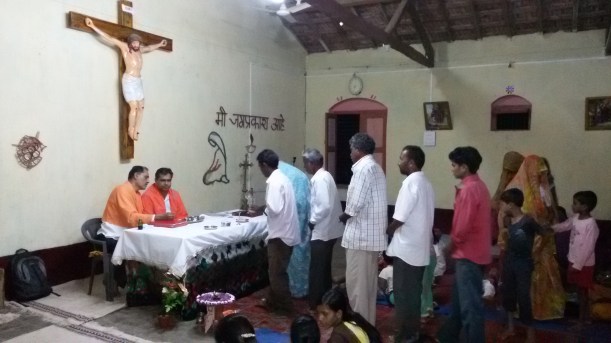
Last year, during my usual annual visit in India during the summer time, I had the joy to celebrate the liturgy with Fr. Neelam Lopes, S.J., Superior of the Missions in Shirpur (North Maharashtra, India). In the photos I am pleased to share I and Fr. Neelam are celebrating Mass in the Indian style for the tribals.

The people of this area belong to the Pawara tribe, a native tribe that is found in the western and central parts of Maharashtra. The Masses are normally celebrated, as seen in the photographs, in one of the halls constructed by the Catholic missionaries. The saffron colored shawls worn by the celebrants is significant to the Indian culture. The color saffron signifies renunciation. Saffron colored clothes are normally used by celibate Hindus (monks and nuns). The language used during the liturgy in these areas is Marathi, which is not the mother tongue of the Pawaras. Marathi is normally the language used during formal functions and in educational institutions. Most of the women seen in the photographs have covered their heads. It is part of the culture of the married Pawara women to cover their heads as a sign of respect.


image

     Fr. Neelam (left) and Fr. Bryan (right) celebrating the Eucharist during the Mass.  (c)Bryan Lobo/Francesco Pesce

image

Fr. Neelam (the first one, wearing a yellow scarf) and Fr. Bryan (sitting close to him wearing an orange scarf ) during the Mass. (c)Bryan Lobo/Francesco Pesce


Leave a comment

The Holy Spirit among the youth in Viet Nam

Sr. Mary Tran 

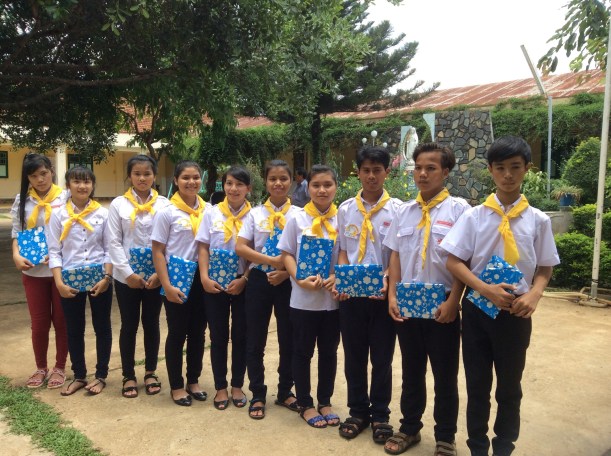
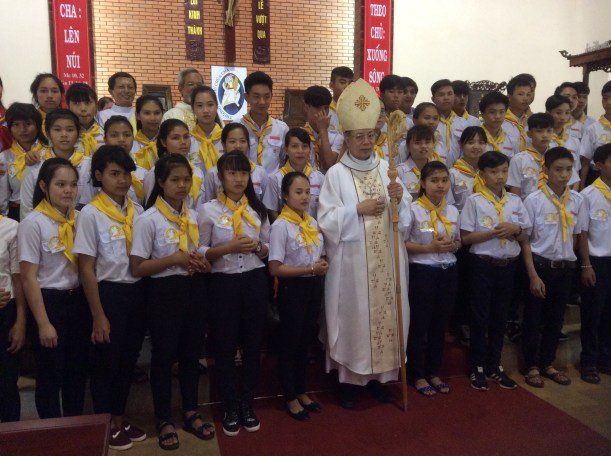
The Bishop of Kontum diocese, Msgr. Aloisio Nguyễn Hùng Vi, recently came to our parish to celebrate the Confirmation Sacrament for 142 chidren. Ten of them are from our boarding school and seven belong to ethnic minority groups. Their parents came the day before and stayed in our house so that they could attend the Mass because they are living very far away.

The pictures are taken in front of the grotto of the Blessed Mother Mary.

(C) Huong Tran, Francesco Pesce


(C) Huong Tran, Francesco Pesce

(C)Huong Tran, Francesco Pesce