ConAltriOcchi blog – 以不同的眼光看世界-博客

"C'è un solo modo di vedere le cose finché qualcuno non ci mostra come guardare con altri occhi" – "There is only one way to see things, until someone shows us how to look at them with different eyes" (Picasso) – "人观察事物的方式只有一种,除非有人让我们学会怎样以不同的眼光看世界" (毕加索)


Leave a comment

Great care for the family 

In  a “Motu Proprio” issued on 8th September and published yesterday, Pope Francis re-founded the Institute for Marriage and Family set up by Saint John Paul II.

The title of this pontifical document is “Summa Familiae Curaˮ (Great Care for the Family) and right at the start recalls the steps taken by the Church after the Bishops’ Synod in 1980 and the Exhortation Familiaris Consortio (On the Christian Family in the Modern World) promulgated in 1981, which gave a more definite form to the Pontifical Institute at the Lateran University.

Today, after two Synods on the family in 2014 and 2015 and after the publication of the Exhortation Amoris laetitia (The Joy of Love), the Church has reached, says Pope Francis «a renewed awareness of the Gospel of the family and the new pastoral challenges to which the Christian Community is called to respond».

On reading the Pope’s document, the great importance of this text and the centrality of the pastoral perspective do not escape us. The Pope talks of an indispensable requirement in his reflections on the family, saying that: “also at the level of academic formation the pastoral perspective and attention to the wounds of humanity must never be lacking”. We do:« well to focus on the concrete reality of the family», given the «anthropological-cultural changes that today influence all aspects of life and require a diversified and analytical approach» and «do not permit us to limit ourselves to pastoral and missionary practice that reflects forms and models of the past ».

A new way of looking at the reality of the family; looking with the eyes of the Spirit, looking with the eyes of the Church as a mother and not just a teacher.

The academic work of the Pontifical Institute, too, is broadening its horizons” both in relation to the new dimensions of the pastoral task and ecclesial mission and with reference to the developments in human sciences and anthropological culture in such a fundamental field for the culture of life».

No-one can question the beauty of the family as announced by the Church. This “Christian” family has contributed much to the good of society and the history of humanity. Now we are seeing that the institutions are creaking, that what once were our certainties and our ties are wavering, and these same sentiments are seeking new forms of expression. Where and how does the Christian family fit in to all this transformation? The foundations of the Christian family are not written on the stone tables of the law, but as Jesus said, the law of the Spirit is written on the “tables of our hearts”. For this reason, above all today, with the strength of the Spirit the Christian family can be an efficient witness to the beauty, the nobleness and profundity of its vocation. With all this in mind, let us now ask ourselves a question: Christian family, what can you tell us about yourself? Allow us to see the beauty and originality of your calling, let us feel the presence of the Lord in your midst. This is almost a silent appeal that the world is making to the Church. The problem is that often it is the Christian families who have lost the “taste of the salt”, they are no longer the “yeast” in the flour of history, no longer the light which illuminates the path. The birth rate in our Western World, the cradle of Christianity, is close to zero and this must make us all think deeply.

Pope Francis is once again is widening our outlook and reforming, rather re-founding an institute which, for a long time, was entrenched in principles often far from reality and refused any change. The Theological Institute will have: «the power to confer iure proprio on its students the following academic degrees: the Doctorate in Matrimonial and Family Sciences, the Master’s Degree in Matrimonial and Family Sciences and the Diploma in Marriage and Family Sciences».


Leave a comment

The “second step”. Perspectives of the Pope’s visit to Colombia

During the traditional inflight  press conference on his journey back to Rome at the end of his pilgrimage to Colombia,  Pope Francis replied to a journalist’s question regarding the possibility of another  visit to that Latin American country one day, saying:“I would at least like the motto of the journey to be ‘Let’s  take the second step”.

Let’s take the first stop was the motto of this pilgrimage and we can truly say that the Pope maintained this impetus: now an entire people is proceeding down the difficult road to reconciliation with faith.

In Colombia,  announcement of the Word of reconciliation is particularly urgent.  We have been entrusted with the Word, the ministry of reconciliation, Saint Paul reminds us in his Second Letter to the Corinthians.

Widening the horizon of his reflection, the Pope also recalled that reconciliation with Creation is   urgent: «we are arrogant, we do not want to see. But the scientists are very clear about the human influence on climate change»

We are living at a time of growing awareness of man’s misdeeds towards Creation.  Creation is deteriorating around us, withering under our blows.  There is urgent need for reconciliation between man and the universe; we should also recognize that an exaggerated Anthropocentrism , often transmitted by a certain Christian theology, has encouraged bad behaviour towards nature. In particular, it is Western man, who is cutting down his forests, suffocating in urban pollution, polluting his seas, who must regain his respect and love of nature.

During this extraordinary pilgrimage, Pope Francis reminded us that the Church is the sign, the watchman who tells us that it is possible, indeed it is in the nature of man, the image of God, to put love at the foundation of the collective experience. Reconciliation with Creation, among men, among peoples, among religions, will not be negated by history, because in Christ the reconciliation has already begun. “God has reconciled us to himself  by Jesus Christ and hath given to us the ministry of reconciliation” (2Cor5,18-20). Let us think about what has been entrusted to us ;we have not been entrusted with the ministry of war, of racism, of nationalism, of populism, of colonialism, we have been entrusted with the ministry of reconciliation.

Saying this we immediately realize that it must be said with a penitential attitude: we are not a reconciled community; Christians are divided; within the Church itself there is the diabolical seed of division.

But why haven’t we been reconciled?  Why doesn’t the Word of God find its rightful place in us?  God said to the prophet: “Thou shalt hear the word at my mouth, and warn them from me”(Ez 33,7).  At times we have announced words which did not issue from the mouth of God; we have said many things, saying they were the will of God and instead this wasn’t true, they were – and at times still are today –  words of power, ideology, moralism, words that win and thus we have become ministers of division. We must not say words that win but words which save.

The Word of the Gospel does not make war, it is not a word that wins but that saves, that loves and reconciles.  We have been entrusted with this Word.  Faith is not a competition, or the defence of any structure, but the road to pursue in history pending full communion with God who will be all in all.

Once again it is the little ones, the children  who can be the true teachers of reconciliation, the Pope reminds us, summarizing a journey which had just ended: “What most impressed me about the Colombians: in the four cities I visited there were always crowds on the streets; fathers and mothers holding up their children to let them see the Pope and so the Pope could bless them.  As if they were saying: “This is my treasure, this is my hope, this is my future. I believe this. ”.  The tenderness. The eyes of those fathers and mothers. Wonderful, wonderful! This is a symbol, the symbol of hope for the future.  A people capable of creating children and showing. A people which is capable of producing children and then showing them, as if they were saying:  “This is my treasure”,  is a people who has hope and has a future”.


Leave a comment

“Let us take the first step”: Pope Francis in Colombia

Departing on 6th September and until the 10th, Pope Francis will be a pilgrim of peace and reconciliation in Colombia. As usual, last night Pope Francis went to the basilica of Saint Mary Major to bring a floral tribute to the venerated icon of Mary Salus Populi Romani and invoke Her intercession for his imminent pilgrimage.

Let us take the first step” is the theme of this apostolic journey because other first steps are required after the signing of the peace agreement.   The Government of Colombia and Farc signed a new peace agreement in Cuba last November which took account of some requests from the Front after the first agreement reached in August after 52 years of war was rejected in a referendum held on 2nd October last.

In the cities the Pope will visit – Bogota, Villavicencio, Medellin and  Cartagena – he will address  several issues: to be the artisans of peace, promoters of life; reconciliation with God, with the Colombians, with nature;  Christian life as Discipleship; human dignity and human rights.

On Friday in Villavicencio, South of Bogota, the Pope will beatify two Colombian martyrs: the Bishop of Arauca, Mons. Jesús Emilio Jaramillo Monsalve and a priest, Pedro María Ramírez Ramos.

Monsignor Jesús Emilio Jaramillo was killed on 2nd October 1989 at the age of 73, while he was returning from a pastoral visit to the town of Fortul. His car was stopped by three armed guerillas belonging to the Domingo Laín Front of the National Liberation Army (ELN) who kidnapped the Bishop; his body was found on the road a day later with several gunshot wounds and without his cross and episcopal ring. Pedro María Ramírez, known as the“ Martyr of Armero” was a rural parish priest, much loved by his parishioners; he was 68 years old when he was beaten to death on 10th April 1948 by a group of Liberal Party supporters in Armero-Tolima because he was considered to be «a fanatical and dangerous conservative».

The Pope will make twelve discourses in which – as highlighted by Cardinal Parolin, who will accompany him – Francis will confirm his brothers and sisters in the faith: “ The Pope’s visit to Colombia is of a purely pastoral nature, like all the Pope’s visits to various Countries and, therefore,  has the aim, the intention – let us say – of confirming and encouraging his brothers and sisters in the faith, of vivifying their charity and spurring them on to live Christian Hope.  Naturally, the papal visit comes at a key moment in the life of the Country as a peace process has begun after fifty years of conflict and violence and this makes it particularly important.”

Both Pope Paul VI and Saint John Paul II had already visited Colombia in 1968 and 1986 respectively. Today it is a Latin American Pope who is arriving to sustain and encourage the difficult path towards Peace following more than 50 years of war between the Government and the Revolutionary Armed Forces of Colombia (Farc), after the signing of the peace agreements last November. However. the situation still hangs in the balance.

Pope Francis is visiting Latin America for the fifth time.   He was in Brazil in July 2013, Ecuador, Bolivia e Paraguay in July 2015,  Cuba in September 2015 and Mexico in January 2016.

As always we will accompany him with our prayers.


Leave a comment

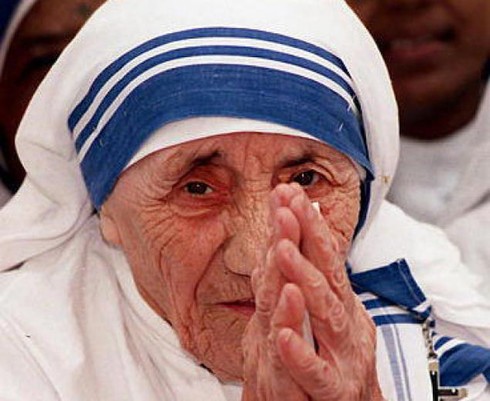
She was able to love even in the darkness

In memory of Mother Teresa of Calcutta, 20 years since her departure

Today is the twentieth anniversary of the death of Mother Teresa of Calcutta, an extraordinary woman of faith and a missionary that was canonized by the Church. The UN Secretary-General Javier Pérez de Cuéllar, on the day of Mother Teresa’s death, said,: “Mother Teresa is the United Nations. Mother Teresa is peace in the world.” These words effectively express the amplitude, the greatness, and the depth of service to life that this little woman has been able to express in faith in God and man, in every man. Today, on his white tomb in the house of Calcutta, pilgrims of all times and of every faith can read a verse of the Gospel of John: “Love one another as I have loved you” (John 15:12).

madreteresa


Before being a woman of action, Mother Teresa was a woman of prayer. This perhaps explains her intrepid strength in a life lived through the miseries and the sufferings of the world. She said of herself and of her sisters: “We are contemplative who live in the midst of the world. […] Our life must be a constant prayer” (R. Allegri,”Madre Teresa mi ha detto”, Ancora Editrice, Milano, 2010). Silence and prayer are even more necessary today to witness Christ with life and charity and to live our mission of men and women in an increasingly complex and difficult world.

In August 1946, she began to hear the “call within a call” as she herself defined it. It was the evening of September 10, while she was on the train going to the city of Darjeeling to do spiritual exercises: “That night I opened my eyes to suffering, and understood the essence of my vocation as its core […] I felt that the Lord was asking me to give up to the quiet life inside my religious community and go out into the streets to serve the poor. It was a command. It was not a suggestion or an invitation or a proposal […]”(R. Allegri, ibidem)). It was an inner calling, a voice in the silence of prayer that pushed her to open herself and serve the poorest of the poor. Mother Teresa has been able to cultivate and practice the evangelical gift of welcome. Welcoming, first of all, in your own time, in your heart, going to find out who was lonely and abandoned. Mother Teresa has made the Church in communion, cutting down every wall of indifference and hypocrisy.

In front of the many calves of so many men and women of our time, in front of the crosses of men of every race and religion, Mother Teresa has been able to contemplate the face of Christ as the measurement of all those who give life for love. With the power of love, this sister who was herself the incarnation of charity, has been able to do a great thing, a divine thing; she gave a name, a dignity to every cross. What does it mean to give a name to the cross?

Jesus in his fullness of Messiah was no longer a Jew, he was the man: “Here is the man.” The name on the cross is Man. Our cultural, ethnic, religious distinctions may be important, but when it comes to the cross, when we die, they no longer matter. This equality is important because Jesus has taken it on himself as an appointment: “And when I am lifted up from the earth, I will draw everyone to myself.” Mother Teresa has been attracted and attracted many to the cross of Jesus son of man, Savior of every man. That is why, just as Mother Teresa did, we must not ask for any religion defense policy, but we must strongly ask for the defense of man’s dignity.

There is an ecumenical and interreligious dialogue of charity, in which Mother Teresa believed a great deal: “There is only one God and He is God to all; therefore it is important that everyone is seen as equal before God. I’ve always said that we should help a Hindu become a better Hindu, a Muslim become a better Muslim, a Catholic become a better Catholic. We believe our work should be an example to the people. We have 475 souls around us; of these, only 30 families are Catholics. The rest are all Hindus, Muslims, Sikh … They are all of different religions, but they all come to our prayers. ” (Lucinda Yardey, Mother Teresa: A Simple Path, Ballantine Books, 1995)

As it is now known, Mother Teresa has also experienced the darkness of faith. In one of his posthumous letters, she wrote that she did not hear “the presence of God in either his heart or the Eucharist.” And she confided: “In my soul I experience just that terrible suffering of the absence of God, that God does not want me, that God is not God, that God does not really exist.”

In those years, Mother Teresa really offered herself to the mystery, once again with the supreme act of donation in love, which she describes with impressive words: “I have begun to love my darkness because I believe it is part of a very, very small part of Jesus’ darkness and pain on earth” (Franca Zambonini,” Madre Teresa: “La mistica degli ultimi”, Paoline, 2003, pp. 33-34)

Mother Teresa has also been able to love the darkness, just like Jesus, who won death with love.

In our blog, in the past we collected some witnesses of devotion to Mother Teresa from an Indian salesian and Indian believers and non-believers.


Leave a comment

Migrants: the “lepers” of today


The Book of Leviticus tells us that not only were lepers banned from their villages, they also had to shout out «Unclean, unclean!» as they approached, to warn others of their presence. This mark of infamy was something that affected them deeply, that scarred their very conscience, to the point of becoming a sort of second nature, something they themselves accepted. We can project this contrast between the village and the leper through the centuries to our own day and age. Today, we are the village, our communities, the old Western countries, our economic system gone mad, even our Church, at times, when it becomes clericalised and unable to reach out, like Pope Francis would like it to do.

But our Western society, despite claiming to be inspired by the great principles of equality and fraternity, which are dear to the tradition of the Enlightenment, which was born and developed in Europe, the heartland of Christianity, seems to be living a huge lie. Apparently, it is willing to integrate outcasts (migrants, illegal immigrants, the homeless, convicts …) into the European and western village, but effectively it is unable to do so. And why is this? Because it should be looking into itself and questioning itself, its actions, what it is becoming and exporting to other regions of the world, but it doesn’t have the guts, or better, we don’t have the guts, to do so.

Migrants are the lepers of the twenty-first century, of the here and now. Society has no greater places of exclusion than the so-called “reception” camps, which, at times, are nothing less than modern-day “lagers”, places where we can confine and conceal our hypocrisy and our selfishness.

Extending the boundaries of our village to make room for the outcasts, updating its rules, becoming a true global village – this is the path that the Pope, today, has shown us once again, with his highly symbolic, yet also very concrete, visit. Because the Pope has said that he wants to give voice to those with no say in society, who are prisoners of an uncertain, even horrible, future … Extending the borders, knocking down the walls, globalising solidarity: these are the last scraps of dignity we can hang on to.

The world and the christless or, worse, listless and indifferent, West, prey to individualistic spiritualist fads, without a shred of charitable empathy, incapable of sharing and donating, must know that Jesus himself was cast out, rejected, forsaken. The Messiah himself, he who was awaited by the prophets (and not by the powerful, or those who just wanted vengeance), like a discarded stone. The child Jesus and the Holy Family of Nazareth lived like migrants, even refugees we might say, for many years before being able to return to their homeland.

Today Pope Francis has reminded us once again, with ever greater strength, that Jesus came to awaken the conscience of the outcasts of today, urging them to stop considering themselves as legitimately cast out, because God is on their side and they must never lose hope. Woe, instead, unto the inhabitants of the village, if they shut themselves inside their walls: woe to the Scribes and Pharisees of today.

Jesus has – once and for all – sanctioned the collapse of the rock on which the enclosed village is built, adorned with its modern evanescent and empty temples: “Not a stone will be left here standing”, unless it becomes a global, caring and open village, open to everybody in the name of our common humanity. We ask the Lord to give us the humility and courage to flatten the walls of the camp, open its gates and extend its boundaries, otherwise we ourselves, and our children before us, will be overcome and stifled by the unassailable fortresses we have raised.


Leave a comment

Exemplary servants of the gospel

Pope Francis pilgrim on the road of Father Mazzolari e Father Milani

In Bozzolo, Pope Francis was welcomed by the Bishop of Cremona, Monsignor Antonio Napolioni, who immediately announced that the process to beatify Don Primo Mazzolari will start on 18th September next.  The Pope then went to the Parish of Saint Peter’s to pray on the tomb of Don Primo Mazzolari where he made a truly memorable address speaking, among other things, of the  “magisterium of the parish priests”.

In Barbiana he was welcomed by Cardinal Giuseppe Betori, Archbishop of Florence and where he also wished to pray at the tomb of Don Lorenzo Milani on the fiftieth anniversary of his death.  In church he met the Prior of Barbiana’s students and then gave a commemorative address in the forecourt of Don Lorenzo’s vicarage which will be very difficult to forget. His educative passion represented faithfulness to the Gospel and to all those who were entrusted to his care, said the Pope.  He then added: “today, the Bishop of Rome recognizes in that life an exemplary way of serving the Gospel, the poor and the Church; take Don Lorenzo’s torch and carry it onwards”.

Don Primo Mazzolari and Don Lorenzo Milani, are ” two priests who offer us a message which we truly need today”, said Pope Francis last Sunday during the Angelus prayer.

Recently, from many places in and outside the Church there have been various analyses and comments on this pilgrimage of the Pope.  Some have spoken of “rehabilitation”, others of “homage” for two priests who were always in the front line of their ministry.  Whatever the right interpretation, it is a good thing to leave room for the facts.  Pope Francis knelt before two great protagonists of the Church and Italian society in the twentieth century, recognizing in them a Church which placed itself at the service of the poor and announced the Mercy of Christ for everyone.  

This act of kneeling is of strong symbolic importance.  As we all know very well, Don Mazzolari and Don Milani were not short of “enemies”, as today there is no shortage of these for Pope Francis. They are enemies of  various origin, especially ecclesial ones and among these there are those who, at the first breath of wind, change flags, ready to change again whenever necessary. It’s like listening once more to the story of St. Paul when he recounts his experience of: “perils among false brethren”    ( 2Cor 11,26).  Opposition to the Church of the Poor and the Last is very active on the web and in some traditionalist blogs.  They accuse the Pope today, as they accused Don Primo and Don Lorenzo yesterday, of having thrown the Church into doctrinal, moral and pastoral confusion. Curiously, these blogs speak to each other, quote each other almost as if they were young Fathers of the Church. In reality, it is these defenders of an old church,  a church that no longer exists, who are in confusion today, who have been an elitist community for much too long, without any  sensitivity and  ignoring different voices, ignoring the poor. During the papacies of John Paul II and Benedict XVI, some lay and clerical pseudo Catholics reduced a part of the Church to a cavern of thieves  behind the backs of the two Popes, carrying on their business intrigues with the powerful people of the times, betraying the Gospel for a few pence; scheming with both the gay and financial lobbies, contracting out all evangelization work to the ecclesial movements, humiliating the parishes and the people of God; pseudo Catholics who defend principles by which they do not live and judge the dramas of people to whom they don’t listen, with whom they share nothing.

It is of paramount importance that we return immediately to the Church of Mazzolari, Milani and Pope Francis who divulge the Gospel with the Spirit of the Council, to attract not to proselytize.

It is with the strength of the prayer of Jesus and the Church as a whole that Pope Francis is undertaking his pastoral mission to bear witness to his brothers in the faith. He started off, as we all know, from the “outskirts”, from the island of Lampedusa, indicating to the world the centrality of both physical and existentialist outskirts.

Today, in Bozzolo and Barbiana, Pape Francis affirmed that the eye of the needle through which we need pass in order to speak to God is the outcast.   Every day, the cries of the outcast strike us, louder and louder,  “overturning” our Church pews, calling our attention back to essential things.

The Pope reminds us that the “Good News” of Jesus is not a new philosophy but the answer to the desire of all men throughout the ages: to be loved and free from slavery.

Whoever cures the wounds of the world, defends his people, teaches true freedom, excludes no-one a priori, is in the very heart of God.

Pope Francis, who came from the “end of the world”, today turned his face towards the entire world and the entire Catholic Church by indicating these two priests as models of the Gospel.

The Gospel reminds us that the Good Shepherd knows his sheep. Pope Francis has made the “ odour of the sheep” the perfume of all missionary works. And it is the odour of the sheep, says Pope Francis, which can reawaken the Church, people’s suffering and solitude, their desire for life and redemption, the frontier on which to build the field hospital which is the Church.

Let us thank the Lord for the gift of Don Primo and Don Lorenzo and let us ask the Spirit to give us the strength to carry on teaching the Gospel with their courage and coherence.  Let us also ask the same Spirit go give us the humility to ask for forgiveness, as baptized persons, as lay persons, as priests and as the Italian Church, from these two great witnesses of Christ.

From today onwards, after this pilgrimage made by Pope Francis, unless the Italian Church, and indeed the entire Catholic Church, follows in the footsteps of Don Mazzolari and Don Milani, it will be a Church that disobeys the Spirit and Peter.


Leave a comment

We do not love in words but with facts

Reflections on Pope Francis’s Message on the World Day of the Poor.

On November 19th, in the 33rd Sunday of Ordinary Time, the first World Day of the Poor will be celebrated by the entire Catholic Church and by men of good will,  which Pope Francis had already announced at the end of the Jubilee of Mercy. On that day as a sign of sharing, after having celebrated the Mass in St. Peter the Pope will invite 500 poor people to lunch in the Paul VI Hall, the audience hall bearing the name of the great pope of Populorum Progressio. The previous day (Saturday 18) there will be a Prayer Vigil in the Church of St. Lawrence outside the Walls, to remember the Roman martyr who recognized the poor as a true treasure in the church.

I invite the whole Church, and men and women of good will everywhere, to turn their gaze on this day to all those who stretch out their hands and plead for our help and solidarity.  They are our brothers and sisters, created and loved by the one Heavenly Father. “(Message for the World Day of the Poor to No. 6).

We do not love in words, but with facts” is the title of Pope Francis’s first message for this day. The Pope speaks of “a thousand faces marked by suffering, marginalization, oppression, violence, torture and imprisonment, war, deprivation of freedom and dignity, ignorance and illiteracy, medical emergencies and shortage of work, trafficking and slavery, exile, extreme poverty and forced migration.“(n. 5).

It is not surprising the fleeting attention, even within the Church, to the proclamation of this world day. Not surprising but bitter, and we are all called to react strongly to indifference to the poor.

Those who have a lot of money and a lot of security are likely to live like the “carefree of Zion” spoken by the prophet Amos, and a whole world is being built, and even if there are thousands of Lazarus at his door, he does not even realize. The rich man of our years sometimes finds out and then makes some alms for the poor, gives some old dress that no longer puts, even though it does not have the Lazarus disorder at its door.

In all the Catholic Church, the parable of rich man is often read but tomorrow Lazarus will be as it is today without any changes. Unfortunately, Jesus’ message has often been imprisoned in the system and we have made it a little harmless; the message doesn’t affects our real life. This is the abyss of which the Gospel speaks. We also all see that the abyss between the Lazarus and the rich man has widened and is widening to a great extent.

We have for centuries determined that we cannot allow the promiscuity between those who are inside and those who are out. Lazarus must be out of the system and from our cities, using the Bible expression, out from the camp. Lazarus then is not only excluded but must also be convinced that it is normal so and  that is right. Exclusion affects him in consciousness.

Our society, however, says that it is inspired by the great principles of Christianity, the Enlightenment, and the Democracy, and then it tries to accept (perhaps not truly)  Lazarus the excluded, but it fails, because it should review its own principles constituent. Immigrants are the Lazarus of the twenty-first century and we only know how to widen the moat.

Christians and all humanity do not forget that God is on the side of the Lazarus, indeed God in this world is Lazarus. Jesus went among the uncleanness to teach them to stop being unclean, and looking at our cities and our system Jesus explained that the real Lazarus, the real immoderate, is our system. This is the Christian Revolution. Jesus came to wake the conscience of the excluded because they ceased to be considered legally excluded, because they know that dignity is their inalienable right. The system then tried to tame Jesus by “promoting him” as a guardian of the order, failing because He went  against a system that excludes, rebellion against political, religious and economic power. For this reason he has been crucified as a Lazarus any: “As a criminal you have hung on a wood” says Peter in the first speech after Pentecost. The Beatitudes tell us that the Lazarus have already won in Christ their battle of dignity. They are meeting us now, and they are millions. They do not want to destroy, but tell us the Word of Salvation that was entrusted to them. Blessed the Poor because yours is the Kingdom of God will tell Jesus. Yours is the secret of life.

Riches are not an end, but an instrument in the hands of men. Often riches have become an iniquitous tool because man has used it to dominate other men and subjugate entire peoples to control some elites. We have arrived in history even to the planned and calculated extermination of the poor, as the prophet Amos recalls. Thanks to God, the cultural progress of peoples is favoring a growing awareness of the need for a fairer distribution of the riches of the planet. Some international organizations and some of the more developed nations are struggling for new social equilibrium, but the battle is still very long and difficult. Jesus invites his disciples to be “shrewd” in the use of riches. He asks for each of us a different relationship with riches both individually and in community. For this reason, the private gesture of alms no longer suffices; we need to act so that wealth can become an instrument of liberation and reconciliation among peoples; this is the concreteness of the gospel, which by its nature is a social fact. History teaches us that not a few have moved away from the Church and the faith because they have received a bad testimony in the use of money and wealth. We are witnessing these years as Christians and citizens of the world with two very important facts. Pope Francis is witnessing the concrete possibility of a poor Church for the poor, and it is an extraordinary gift from the Lord, an example that stimulates us for new conversion. Moreover, at the same time, we are witnessing the fact that many poor people are – we would say so-resuming the gospel, often hidden behind them, in words of circumstance and humiliating alms. The poor today are aware that the gospel is first and foremost for them, and are no longer willing to wait for their rights and dignity. We carefully read and meditate in this regard the prophetic words of Don Primo Mazzolari, a poor priest among the poor to whom Pope Francis will honor, praying on his grave in a few days:I have never counted the poor because the poor cannot count; the poor embrace, they do not count. Yet there are those who keep the statistics of the poor, and they are afraid; Fear of a patience that can also be tired, afraid of a silence that could become a scream, afraid of a lament that could become a song, afraid of their rags that could become a flag, fear of their tools that could be barricaded. ” This is already happening.


Leave a comment

Eucharist bread for all


“For as often as you eat this bread and drink the cup, you proclaim the death of the Lord until he comes”

The earliest text on the Eucharist – the Letter to the Corinthians (53/57) – speaks to us about the fact that the Eucharist is in connection with the death of Jesus. The Lord is dead delivering himself and allowing himself to be taken from his enemies. Celebrate the Eucharist wants to teach us how to live. We hate to lives by giving ourself  as did Jesus and as also did the apostles. A Church that thinks to defend itself, is no longer a church.

It is the Gospel to live by delivery and it is the path to be fulfilled to have eternal life. We celebrate the Eucharist “as long as he comes”, waiting for him to return, believing that death has not defeated him, because those who live by giving for love have a stronger life than death.

The Eucharist is a way of life, not a rite. We are all very concerned at the risk of reducing the Eucharist to a private, intimate devotion, as if everything could be resolved in the exclusive relationship between myself and the Lord, closed to others and history. There are two current dangers in this regard.

In the book of Deuteronomy, we see the danger of nostalgia of other times: the people with the hard cervix resists the Spirit. Even today we have some people like that, resent the times of tranquility and of triumphant church, when the churches were full, and the lavish liturgies, the imposing ostensors to “suffocate” the fragility of the Sacred Ostia; Times which were, however, of injustice, of power, of money, of clericalism, where Christ was not there.

The danger of spiritualism And the bread that I will give is my flesh.God’s life is not outside of human reality. There can be no gift of the Spirit where there is also the gift of the flesh. Jesus specifically says in chapter 6 of the Gospel of John: “Whoever meats my flesh.” The chewing verb in Greek is very strong and means “shredding, shattering”. The Gospel is not an ideal, but the concordance of bread and flesh.

imageLuke’s Gospel in the tale of the multiplication of loaves and fish also offers us a very important indication

Everyone ate and satiated, and twelve baskets were carried out of their advanced parts.

There is no one who, coming to the banquet of the Messiah, is forced to return to fast. Indeed, there are loaves that are reserved to those who are left out of the canteen. We think, and pray, for all Christians living in a state of persecution, and can not celebrate the Eucharist; Pray for those who can not approach the sacraments and await the mercy of the Lord and the Church, not the hardness of the law; We pray for churches on mission land, where the priest arrives once a month; Pray for all those who have never met who the Lord, and also for those who have gone away for our fault and our contradictions. Let us pray because at the table to which Jesus wanted to sit, there really is a place for everyone, and no one is excluded, no one is missing; Perhaps then that will be the day he will return.


Leave a comment

When praying say Father

For nearly two millennia Christian prayer was within the daily rhythms of individual and social life, had its deadlines, its rituals, its prescriptions, but also its hypocrisy. For example, we can think to the medieval rite of Carroccio. In that period, the Italian municipalities, before joining a battle, deployed a wagon on which the Eucharist was celebrated, and immediately afterwards war began killing each other. This example reminds us that symbols and rites are not enough to identify prayer.

Jesus’ words say what prayer is. Jesus gives us the model of prayer, a simple thing, that in its simplicity casts light on our often complicated way of praying. Praying means recognizing our needs and our fragility to be creatures. In fact, strong and superb men do not pray but rather they are praying. Prayer then expresses humility before God and in front of other men. “When you pray, say, Father” is the simple imperative of Jesus. All the prayers of Jesus begin with this word Father. With God we have not to use the words of His divinity (eg the omnipotent). The word divine and human is Father, because Jesus has come to restore the relationship between the Father and us children in the Son. Jesus then gave us a single guarantee as a fruit of prayer; The Father will give the Holy Spirit. What does the Spirit need? The Spirit is the love of the Father and of the Son for each of us. God responds to our prayers by not leaving us the laws to obey and by giving his Spirit, guiding us infallibly in our daily lives. In this regard, the liturgy today offers two significant verses:

“I must go down and see whether or not their actions fully correspond to the cry against them that comes to me. I mean to find out “(Gen 18,21). We have to learn looking at our personal history, and we have to see the world with the eyes of the Spirit and not with those of the law. We find every day that confidence and serenity that the Lord promised us giving His Spirit.

In Christ, God also gave life to us, “obliterating the bond against us, with its legal claims, which was opposed to us, he also removed it from our midst, nailing it to the cross (Col 2:14). We ask the Lord in prayer to help us to remove the prescriptions that humiliate man and are a barrier to mercy. Be humble  people who are preventing mercy, appealing to pseudo-doctrine or to a pseudo-tradition that instead represents men’s precepts as Jesus told. These people are not able to pray and do not know how to love.


Leave a comment

The Spirit sends away the fears of the world

The Cenacle, which had seen the Apostles witnesses of the Lord’s Supper, is the place where they had been together to hear His Word many times and now the Cenacle becomes a refuge, a hiding place “for fear of the Jews” as the Evangelist John remembers. And the Acts say to us, “When the time for Pentecost was fulfilled, they were all in one place together.” (Acts 2: 1).

We have to remember that the Apostles in Jerusalem had few friends because they had been opposed to religious and political power, and they were considered  fanatical followers of one of the many messianic factions of the time. They threatened their lives to just preach that Jesus was the Son of God who was truly dead and truly resurrected. And in fact, the Acts tell us that soon the first martyr arrived: Stephen, who is stoned.

Today what are our fears, which make us lock in our groups? If we exclude the Church of the martyrs who, as we well know, still exists in many parts of the world today, we notice that there is also a strong temptation in the Church and among Christians to lock in an elite, often sectarian, excluding the world, seen as evil and an enemy of which to be afraid, and therefore tends to judge rather than love. It may happen that sometimes our faith, our Christian community, our ecclesial group, instead of being a space of fraternity and proclamation of the Gospel, turn into an impregnable fortress, where those in the interior judge the ones outside and also exclude them . “Outgoing Church” according to the teaching of Pope Francis also means not to be afraid and not to judge, but on the contrary be strong in the faith and widen the spaces of welcome.

he-qi-pentecost1

It is in this climate of fear and closure that breaks the Spirit. “And suddenly there came from the sky a noise like a strong driving wind, and it filled the entire house in which they were.” (Acts 2: 1). In that cenacle that has become closed and frightened, the Spirit intervenes, acts and transforms it, changes the hearts of those deceived men and recreates a new fraternity extended to the ends of the earth. That is why everybody was talking in their native language, always remembering the Acts.

Even today the Spirit calls us to look forward, to open the spaces of our heart, to listen to the Word. The Gospel is not a script to be copied, the Church is not a museum to guard. The Christian community of the origins had the courage of the Spirit to welcome the un-circumcised, dared to write the Good News, and it was pilgrim to the boundaries of the known world. Today, it is our time to transmit ‘the Gospel that we have received’, without fear, shame, and wherever we go in this globalized world. “The Advocate, the holy Spirit that the Father will send in my name – he will teach you everything and remind you of all that I told you.” (Jn 14:26).

It is not a simple thing to witness the Church of Pentecost, because it is the Church of Joy (as the Blessed Pope Paul VI reminded us) but also of martyrdom. Nobody feels that we have not have to pay a price, even personal. On the contrary, living the gospel of sacred habits, locked in the sacristies, hidden behind the smell of incense is undoubtedly easier. The Spirit instead calls us to risk the paths of life, to walk the way (ódos), just as the Gospel is called in the Acts of the Apostles. The hardest language to speak is that of who we meet, who is facing us, who will be against us, perhaps believing they do well. The Spirit teaches us to talk about that too.